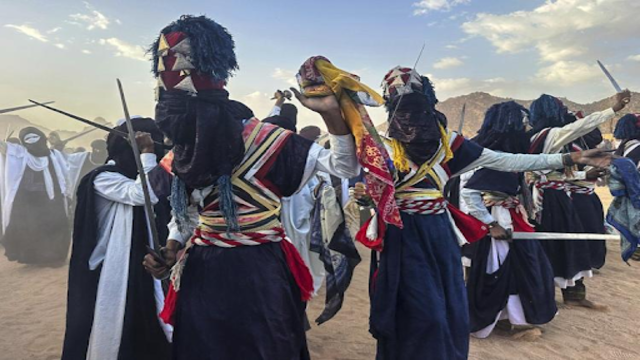
Zelouaz, Algeria dancers perform on the last day of the Sebeiba festival in Djanet, a southeastern Algerian oasis town in the Sahara desert, on July 6, 2025. (AP Photo)
With one hand gripping a sword and the other a scarf, dancers move in rhythm. Their steps are slow and steady, surrounded by women singing in harmony, dressed in flowing garments and shimmering jewelry. This is Sebeiba—a living celebration of peace, heritage, and spirit in the heart of the Sahara.
Held every year in Djanet, a desert town tucked in southeastern Algeria near the Libyan border, Sebeiba isn’t just a festival—it’s a cultural heartbeat. For the Tuareg people, who call the vast Sahara home, this 10-day event is a moment of deep pride, memory, and community.
Djanet’s Desert Dance Honors Peace, Heritage, and Ancestry
The Sebeiba dance dates back over 3,000 years, and with it come tales passed down through generations. One story recounts that the Tuareg of Djanet initiated the tradition to celebrate the defeat of the Pharaoh by Moses—a joyful response to deliverance and survival. Another tells of an old rivalry between two Djanet neighbourhoods, Zelouaz and El Mihan, that ended with a commitment to peace.
The dance, often called the “war without bloodshed” or the “dance of peace,” is a powerful expression of both. It’s not about combat, but connection.
A dancer from El Mihan, Algeria prepares for the Sebeiba festival dance competition in Djanet, a southeastern Algerian oasis town in the Sahara desert, on July 6, 2025. (AP Photo)

Dance, Color, and Competition
On the final day of Sebeiba, the desert square between Zelouaz and El Mihan turns into a vibrant stage. The young men of each neighborhood face off in a dance competition judged by elders from a neutral zone—Adjahil. Their movements are bold and symbolic, performed in dramatic robes and tall maroon hats called Tkoumbout, decorated with gleaming silver.
It’s not just about footwork. The group with the most striking costumes, poetic chants, meaningful dances, and soul-stirring songs takes home the honor. This year, El Mihan claimed the win, but for the Tuareg, the title is only part of the story.
“Sebeiba is sacred,” says Cheikh Hassani, who leads the Indigenous Dance Institute of Sebeiba. “It’s about memory, unity, and honoring our roots.”
A Tradition Embraced by All Ages - Sebeiba Lives On
As drums echo across Djanet, children join in too—boys wielding tiny swords and scarves, girls keeping time with the women. Night after night in the days leading up to the main event, families gather under cooler skies to rehearse and celebrate.
Even when the sun blazes—this year peaking at 38°C (100°F)—the spirit of Sebeiba remains unshaken. More than 1,000 people showed up to witness the final dance on July 6, coinciding with Ashoura, a significant date in the Islamic calendar.
Sand rock formation in the Sahara desert outside the city Djanet, a southeastern Algerian oasis town in the Sahara desert, on July 5, 2025. (AP Photo)

A Heritage Shared with the World
Thanks to its cultural richness, Sebeiba earned UNESCO recognition in 2014 as an Intangible Cultural Heritage of Humanity. And it’s not just locals who appreciate it. Around 50 foreign tourists from countries like France, Poland, Germany, Libya, and Niger joined the festivities this year.
Tourism in Djanet is growing fast. Algeria’s government recently launched a visa-on-arrival program for Sahara visitors and added direct flights from Paris, boosting interest in this ancient oasis.
But to the people of Djanet, Sebeiba is much more than a tourist attraction.
“It belongs to all of us now,” Hassani says. “But we’re proud to be its guardians.”