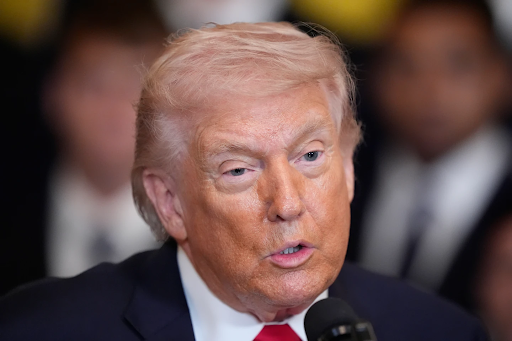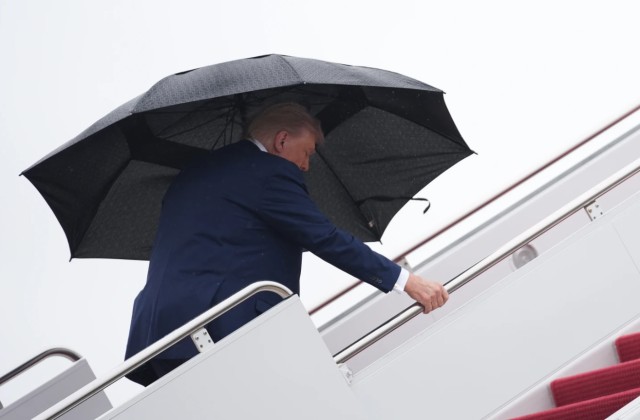
President Donald Trump boards Air force one, Sunday, Oct 12, 2025.
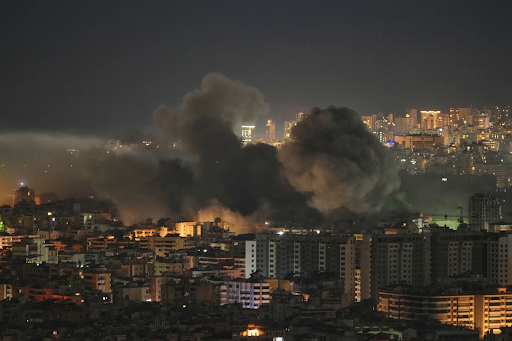
World leaders have gathered in Egypt’s Red Sea resort town of Sharm el-Sheikh for a historic peace summit aimed at cementing the newly agreed Gaza ceasefire. Co-chaired by U.S. President Donald Trump and Egyptian President Abdel Fattah el-Sissi, the “Summit for Peace” seeks to end the devastating two-year war in Gaza and pave the way for long-term regional stability.
While Israel and Hamas are not attending, their absence underscores the summit’s focus on building international consensus to sustain the truce and manage the post-war transition.
Ceasefire Sparks Hope for a New Beginning
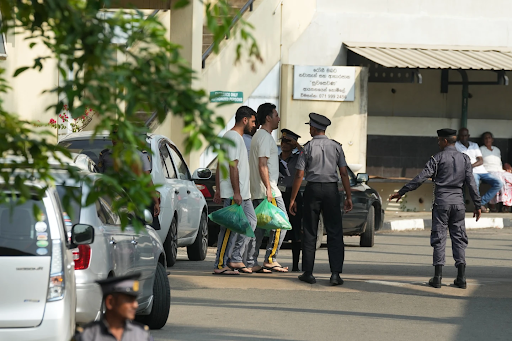
The summit takes place as a key prisoner exchange unfolds — Hamas is set to release 20 remaining Israeli hostages, while Israel will free hundreds of Palestinian prisoners. These moves follow the formal start of the ceasefire on Friday, raising cautious optimism that both sides may be ready to step back from further escalation.
However, despite this progress, uncertainty remains. Many fear unresolved issues could reignite the conflict if not managed carefully.
Why the Gaza Peace Summit Matters
The peace summit follows intense diplomatic pressure from the United States, Arab states, and Turkey to stabilize the ceasefire’s first phase. Both Israel and Hamas require extensive international support — financial, political, and logistical — to navigate the complex steps ahead.
President El-Sissi’s office said the summit’s goal is to “end the war in Gaza and open a new chapter of peace and regional stability,” echoing Trump’s vision for a redefined Middle East peace framework.
A Vision for Post-War Gaza
Earlier this year, Egypt proposed a postwar plan allowing Gaza’s 2.3 million residents to remain in their homeland — countering earlier ideas of depopulating the territory. Now, with U.S. backing, Cairo aims to implement this plan, emphasizing reconstruction, security reform, and humanitarian recovery.
In the first phase of the deal, Israeli troops have pulled back from parts of Gaza, enabling thousands of displaced Palestinians to return home. Aid groups are preparing to deliver long-delayed humanitarian supplies, marking a major milestone after months of isolation.
Hostage Swap and the Challenge Ahead
The delicate hostage and prisoner exchanges have presented significant logistical hurdles. Beyond that, negotiators face deeper challenges — disarming Hamas, establishing a legitimate post-war government in Gaza, and determining the extent of Israel’s military withdrawal.
The U.S. plan calls for regional and global partners to help form a new Palestinian security force. Funding reconstruction will also be critical. The World Bank and Egypt estimate Gaza’s rebuilding needs at over $53 billion, prompting Egypt to plan a dedicated reconstruction conference in the coming months.
Key Players and Notable Absences
While major powers like Turkey, Jordan, Britain, Germany, France, Italy, the UN, and the EU are attending, two crucial parties — Israel and Hamas — are not. Their indirect negotiations continue via Egypt and Qatar, both serving as mediators.
Iran, a major Hamas backer, is also absent. Despite framing the ceasefire as a victory for Hamas, Iran faces declining regional influence and growing domestic challenges, reducing its leverage in shaping Gaza’s future.
Leaders Push for Stability and Recovery
The summit is expected to see leaders commend Trump’s diplomatic efforts. For President El-Sissi, the event marks relief after fending off earlier proposals to depopulate Gaza. Turkish President Recep Tayyip Erdogan, whose nation helped broker the ceasefire, is among the attendees, alongside Jordan’s King Abdullah, who plans to help train the new Palestinian security forces.
Germany’s Chancellor Friedrich Merz will co-host the upcoming Gaza reconstruction conference with Egypt. Britain’s Prime Minister Keir Starmer has pledged £20 million ($27 million) for Gaza’s water and sanitation, and will host a three-day coordination summit for reconstruction efforts.
UN Secretary-General António Guterres, EU President António Costa, and Italy’s Prime Minister Giorgia Meloni are also attending.
Sharm el-Sheikh: A Symbol of Peace
Known for its scenic beauty and historic significance, Sharm el-Sheikh has long been a symbol of diplomacy. Once a flashpoint of past wars, it has evolved into a venue for peace and cooperation.
From hosting peace talks under former Egyptian presidents to today’s Gaza Ceasefire Summit, the resort town once again stands at the crossroads of history — as global leaders strive to transform a fragile ceasefire into lasting peace.