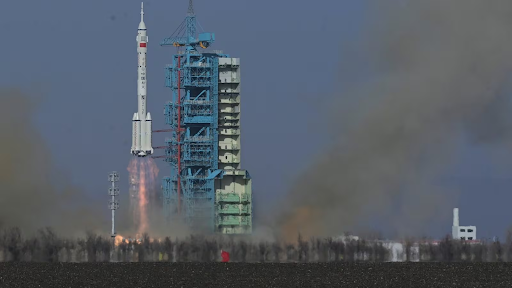
This photo from China’s Xinhua News Agency shows the Shenzhou 22 spacecraft lifting off from the Jiuquan Satellite Launch Centre in northwestern China on Tuesday, Nov. 25, 2025. AP Photo
China launched the Shenzhou 22 spacecraft on Tuesday in response to a safety issue that left three astronauts without a reliable way home. The launch aimed to secure a safe return path for the crew now working aboard the Tiangong space station. The craft reached Tiangong the same day and docked without trouble.
The three astronauts arrived at the station on November 1. They will use Shenzhou 22 for their return trip sometime in 2026. The launch restored confidence in the mission after an earlier incident raised concerns.
Damage delays previous crew’s return
The concern began earlier this month when astronauts from the Shenzhou 20 mission prepared to head home. Their return capsule suffered window damage, forcing officials to delay their departure by nine days. That crew eventually used the Shenzhou 21 spacecraft to return, after it carried the next team of astronauts to Tiangong.
Although the Shenzhou 20 team landed safely, the replacement crew suddenly had no confirmed return craft. If an emergency occurred, they had no guaranteed way to leave the station. The problem triggered swift action from China’s space authorities.
The damaged Shenzhou 20 spacecraft still orbits the station. Officials plan to bring it back to Earth later for full inspection. State media reported that the spacecraft did not meet the safety rules needed for crew transport.
Ensuring safety for the working crew
The launch of Shenzhou 22 ensured that the current three-person crew once again has a safe exit plan. Safety remains a major focus as China continues to expand its space program. This mission also highlights how quickly crews rotate in and out of Tiangong as China builds up experience with long-term space operations.
While the International Space Station continues to host teams from many countries, China operates Tiangong independently. The U.S. restricts China from taking part in the ISS due to concerns tied to China’s military-controlled space program. That decision pushed China to build its own station from the ground up.
Tiangong continues to grow
Tiangong, which means “Heavenly Palace,” took shape piece by piece beginning in 2021. The station welcomed its first astronauts that same year. Although smaller than the International Space Station, Tiangong represents a major step forward for China’s ambitions in space. Crews work on research projects, station upgrades and a growing range of scientific tests.
China hopes Tiangong will host constant activity for many years, much like the ISS. Launches such as Shenzhou 22 underline China’s commitment to maintaining a steady presence in orbit.
The latest mission also highlights how space travel still carries risks, even with extensive planning. China’s choice to send another craft shows its focus on protecting crew safety and keeping the station’s operations running smoothly.