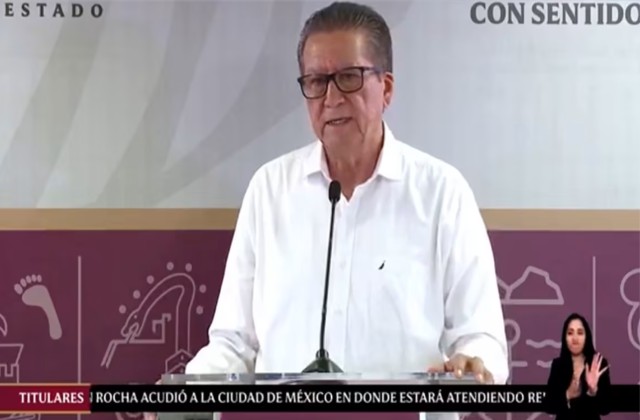
Sinaloa Secretary General Feliciano Castro Meléndez speaks during a press conference on Monday, June 30.
A horrifying scene shocked residents in Sinaloa, Mexico, after authorities discovered 20 bodies — five of them decapitated-on a bridge along a federal highway in the city of Culiacán. The incident, now under investigation by state prosecutors, is a grim reminder of the growing violence gripping the region.
Local media outlets reported the presence of a message hanging above the bridge where the bodies were found. While the contents of the message remain undisclosed, officials have confirmed that it will be investigated as part of the ongoing probe.
Feliciano Castro Meléndez, Sinaloa’s Secretary General, described the situation as “regrettable” and stated that it reflected the deep insecurity affecting the state. The discovery points once again to the escalating cartel warfare that continues to plague northern Mexico.
Culiacán: A City Under Siege
Since early 2024, Culiacán has become the battleground for violent turf wars between rival groups within the powerful Sinaloa cartel. Once known for its relative peace compared to other cartel strongholds, the city is now experiencing relentless clashes.
The two most prominent factions involved are “La Mayiza,” which follows the leadership of Ismael “El Mayo” Zambada, and “Los Chapitos,” a group loyal to the sons of Joaquín “El Chapo” Guzmán, the infamous drug lord now imprisoned in the United States.
This power struggle has intensified in the past year following key arrests and shifting alliances, leading to an explosion of violence on Sinaloa’s streets.
Arrests Trigger Bloody Fallout
The recent escalation is linked to the capture of Joaquín Guzmán López, one of El Chapo’s sons, and El Mayo Zambada himself. Both were arrested in 2024 by U.S. authorities in a high-stakes sting operation that reportedly involved luring them onto a flight under false pretenses.
Instead of landing in Mexico, the flight touched down in El Paso, Texas, where U.S. federal agents were waiting. While Mexican officials claimed the two agreed to surrender voluntarily, lawyers representing the men disputed this version of events.
Zambada’s attorney described the incident as a “violent kidnapping,” while legal representatives for Ovidio Guzmán López, another of El Chapo’s sons, called the surrender narrative “a complete and utter fabrication.”
Ovidio Guzmán’s Legal Twist
Ovidio Guzmán, who was extradited to the U.S. in September 2023, initially pleaded not guilty to multiple drug trafficking charges. However, in May, court documents revealed that he had agreed to change his plea — a possible sign of a broader deal with U.S. prosecutors.
Following this shift, several members of his family reportedly entered the U.S., according to Mexican Security Secretary Omar García Harfuch. He suggested this move could be linked to a Justice Department-negotiated plea arrangement.
This development hints at deeper negotiations behind the scenes, possibly shaking the cartel’s internal balance and further fueling factional violence.
El Chapo’s Legacy Lives On
Despite these high-profile arrests, the cartel remains a dangerous force. Two of El Chapo’s sons — Iván Archivaldo Guzmán and Jesús Alfredo Guzmán Salazar — are still at large.
U.S. authorities have accused them of leading major drug operations and offered $10 million for information leading to each of their captures.
Their continued freedom only intensifies the rivalry within the cartel and the deadly battles being fought in cities like Culiacán.
A Region Caught in a Deadly Cycle
The discovery of 20 bodies on a public bridge is not just a gruesome headline — it is a stark symbol of the deepening crisis in northern Mexico. As the Sinaloa cartel’s internal war spirals further out of control, civilians are left living in fear.
Unless significant action is taken to dismantle the cartel’s operations and reduce its grip on the region, incidents like this will likely continue. Sinaloa remains a flashpoint in Mexico’s ongoing war on drugs, one with no clear end in sight.