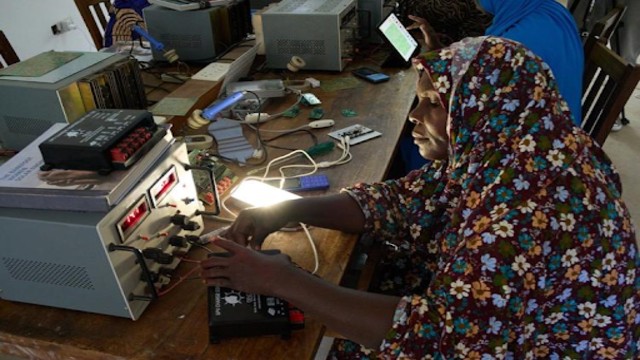
A Solar Mama technician wires up a solar charge controller at the campus of Barefoot College International in Kinyasini, Zanzibar, July 23, 2025. (AP Photo)
When night fell in Zanzibar, the darkness often came with smoke.
For years, Hamna Silima Nyange relied on oil lamps to light her small home on Tanzania’s picturesque archipelago. Like nearly half of Zanzibar’s two million residents, her house wasn’t connected to the national grid. The dim, smoky lamps strained her eyes and barely gave her eight children enough light to study.
Everything changed when a neighbor, Tatu Omary Hamad, installed solar panels and bright bulbs on her roof.
“Today, we have enough light,” Nyange said with relief.
Women Powering the Change
Hamad is among dozens of women known locally as “solar mamas.” Trained by Barefoot College International — a global nonprofit promoting rural electrification and women’s empowerment — they bring solar energy to Zanzibar’s most remote communities. So far, the initiative has illuminated more than 1,800 homes across the islands.
The program focuses on middle-aged women, many with little or no formal education. Over six months, they learn how to install, maintain, and repair solar systems. When they return home, each woman brings at least 50 complete solar panel kits and the tools to maintain them — turning their villages into small hubs of clean energy.
“We want to train women who become change makers,” said Brenda Geofrey, director of Barefoot College International Zanzibar. “They are trusted, rooted in their communities, and ready to lead.”
From Learners to Leaders
Barefoot College’s Zanzibar campus has been running for ten years. Before that, women were sent to India, where the organization was founded.
Among the early trainees was Khazija Gharib Issa, an unemployed widow who is now a master trainer.
“I got a job. I got a place to stay. Before, I didn’t have one,” she said proudly.
For many women, the program isn’t just about energy. It’s about independence, confidence, and respect — qualities that transform entire families.
Clean Energy, Better Health
The solar initiative also brings crucial health benefits.
Oil lamps, often powered by kerosene, emit harmful smoke that can cause respiratory and eye problems. They are also fire hazards in cramped homes.
“Using kerosene has many problems,” said health worker Jacob Dianga. “Clean energy helps protect our health.”
Alongside solar training, Barefoot College offers courses in tailoring, beekeeping, and sustainable agriculture — each combined with basic health education. Graduates become advocates for healthier living in their communities.
Breaking Barriers, Building Futures
Despite its success, the program faces challenges. Funding remains uncertain as global aid budgets shrink. Social barriers persist too, especially in communities where women’s roles are traditionally confined to home.
“In many African communities, women are seen as homemakers,” Geofrey explained. “But these women are proving that they can also be innovators.”
Some husbands have resisted allowing their wives to train, but attitudes are changing as results become visible.
“People used to say this work was for men,” Issa recalled. “They laughed at me. But now they see the light in their homes and respect what I do.”
From smoky lamps to solar-powered homes, Zanzibar’s “solar mamas” are not just bringing light — they’re rewriting what empowerment looks like, one rooftop at a time.