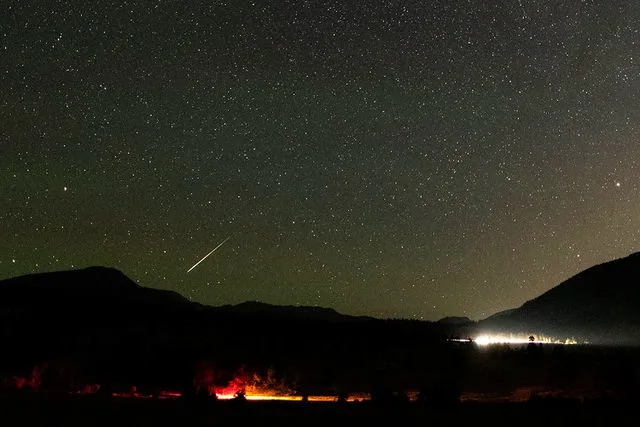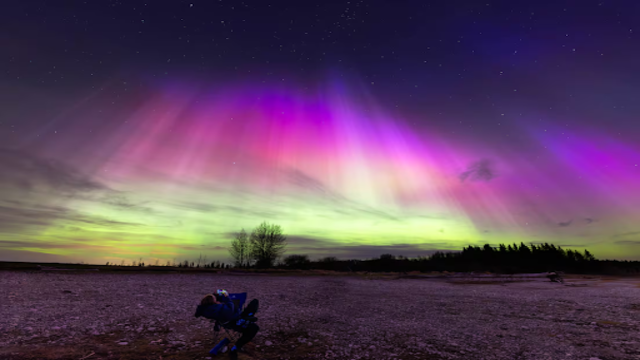
A viewer admires a stunning northern lights show on May 10, about 80 kilometres from Airdrie, Alberta. More aurora displays are expected later this week. CBC
Space weather experts are warning that a powerful solar storm could reach Earth this week, bringing brilliant northern lights across much of Canada and parts of the northern United States. The same event may also cause temporary disruptions to communications and navigation systems.
Forecasters say several bursts of energy from the sun, known as coronal mass ejections, are racing toward Earth and could arrive Tuesday night or early Wednesday morning. The storm could create some of the most vivid aurora displays of the year.
According to the U.S. National Oceanic and Atmospheric Administration (NOAA), the geomagnetic storm could briefly affect GPS signals, radio communications, and even power grids in some regions.
Auroras Expected Across Canada
NOAA’s Space Weather Prediction Center released maps showing that colourful auroras could be visible across nearly all of Canada on both Tuesday and Wednesday nights. Some northern U.S. states may also get a glimpse of the shimmering lights.
How bright and widespread the displays become depends on the timing and strength of the solar particles as they reach Earth’s magnetic field. The interaction between those particles and the planet’s atmosphere produces the glowing colours that light up the night sky.
Experts say that if skies stay clear, Canadians from coast to coast could witness a spectacular show.
Why Northern Lights Are Increasing
The sun is currently at the most active phase of its 11-year solar cycle, a period known as the solar maximum. During this time, the sun releases more magnetic energy, which increases the number of solar flares and coronal mass ejections.
This extra solar activity means more chances for auroras to appear farther south than usual. In recent years, Canadians have reported seeing the northern lights in areas where they’re rarely visible.
Scientists explain that the sun’s poles reverse every 11 years, creating magnetic twists that boost activity on its surface. As a result, more particles are launched toward Earth, lighting up the skies in brilliant greens, pinks, and purples.
Past Solar Storms and Their Effects
Solar storms don’t just create stunning visuals — they can also affect life on Earth. When charged particles hit the planet’s magnetic field, they can cause power surges, disrupt radio transmissions, and interfere with satellites.
History shows the power of these storms. In 1859, a massive solar event sparked auroras as far south as Hawaii and even set telegraph wires ablaze. In 1972, another storm reportedly triggered magnetic sea mines off the coast of Vietnam.
Experts can’t predict solar storms far in advance, but they can issue warnings a few days before an eruption reaches Earth. This allows governments and utility companies to prepare for potential disruptions.
Best Way to Watch the Auroras
Skywatchers hoping to see the lights should head to a dark area away from city glare. Open fields, rural parks, or lakesides often provide the best views.
Experts recommend checking the latest aurora forecast from the Space Weather Prediction Center or using an aurora-tracking app.
If clouds stay away, even smartphone cameras may pick up colours too faint for the naked eye.
With several solar outbursts headed our way, this week could be one of the brightest nights for aurora lovers across Canada.