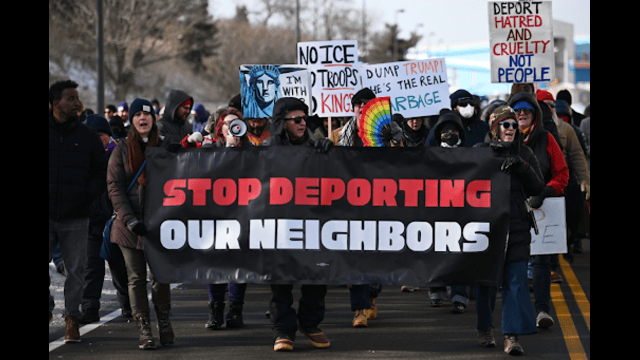
Protesters gather at a rally for immigrant and worker outside Signature Aviation near the Minneapolis–Saint Paul International Airport, Wednesday, Dec 3, 2025, in Minneapolis.
The largest Somali community in the United States, based in Minnesota, was stunned Wednesday after former President Donald Trump launched a new series of harsh remarks targeting Somali immigrants. The comments deepened fears, amplified political tensions, and revived long-standing concerns about anti-immigrant rhetoric in national politics.
Trump’s Remarks Trigger Outrage
Trump criticized Somali immigrants during a Tuesday Cabinet meeting, saying they “contribute nothing” and describing them as “garbage.” He claimed the country was “going the wrong way” by allowing them in.
A day later, he repeated the attacks.
“Somalians should be out of here,” he said from the Oval Office. “They’ve destroyed our country.”
He also mocked Minneapolis Mayor Jacob Frey, calling him a “fool” for defending the Somali community.
His remarks stunned many in Minneapolis, home to the nation’s largest Somali diaspora.
Somali Americans Respond with Strength
For Hamse Warfa, a Somali-born entrepreneur and education nonprofit leader, the comments crossed a line.
“I am not garbage,” Warfa said. “I’m a proud American citizen.”
Warfa has built several businesses and now runs World Savvy, a national education nonprofit. He said Trump’s comments reflect a pattern of attacking immigrant groups for political gain.
“Last election it was Haitians,” Warfa said. “Now it’s Somalis.”
A Community Rooted in Minnesota
The Minneapolis–St. Paul region is home to approximately 84,000 Somali Americans, nearly one-third of the country’s Somali population.
Somali refugees began settling in Minnesota in the 1990s, drawn by social services and a growing diaspora. They revitalized neighborhoods, opened businesses, and became part of the state’s political and cultural fabric.
Today, Somali Americans serve in the state Legislature, on city councils, and in Congress, including Rep. Ilhan Omar, whom Trump also called “garbage.”
Immigration Enforcement Concerns
Trump’s remarks came as reports surfaced of a possible targeted immigration enforcement operation aimed at Somalis living illegally in the U.S. Most Somali Minnesotans, however, are U.S. citizens or legal residents.
Community leaders noted unconfirmed reports of detentions but lacked details. Federal officials declined to comment.
The administration also announced pauses on immigration applications and halted asylum processing following the shooting of two National Guard soldiers by a suspect originally from Afghanistan. Somalia was among 19 countries affected by the application freeze.
Fraud Allegations Cast a Long Shadow
Minnesota’s Somali community has faced scrutiny after several individuals—many Somali Americans—were arrested in recent years in connection with fraud schemes involving social services.
Trump amplified these allegations last week, calling the state “a hub of fraudulent money laundering.” He suggested, without evidence, that funds were being funneled to al-Shabab, an extremist group in Somalia.
Federal prosecutors, however, have not charged anyone with supporting terrorism, and officials say credible proof linking fraudulent money to militant groups is lacking.
Leaders Push Back Against Attacks
Political leaders in Minnesota condemned Trump’s comments.
“Minneapolis will remain a city that stands up for our residents,” Mayor Frey said.
Gov. Tim Walz, several Democratic lawmakers, and multiple City Council members held a news conference urging Republican colleagues to denounce the rhetoric.
“Where are the Republicans now?” asked state Sen. Zaynab Mohamed, calling for bipartisan rejection of the attacks.
Families Face Emotional Fallout
Warfa says the rhetoric affects families deeply. One of his daughters, a high school senior, is preparing for college. He wishes political hostility didn’t overshadow daily life.
“I’d rather focus on taking her to college tours,” he said.
“Instead, I’m being talked about as ‘garbage’ by the president of the United States.”
The Somali community, long established in Minnesota, now braces for an uncertain and tense political climate as national immigration debates resurface once again.