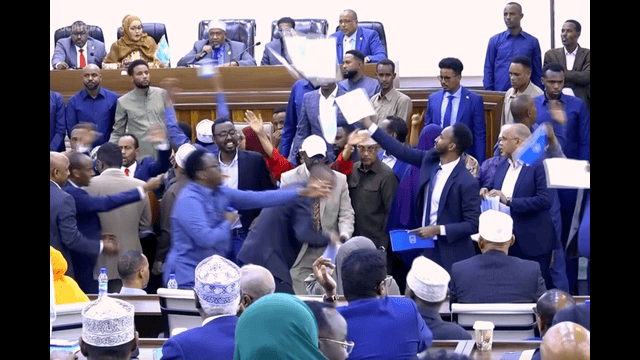
This image taken from an Associated Press video shows a scuffle between lawmakers during a joint session of Somalia’s parliament Wednesday, Jan. 28, 2026, in Mogadishu, Somalia
Somalia’s parliament descended into chaos on Wednesday after a sudden push to debate constitutional amendments.
The disorder forced the suspension of a joint parliamentary session and raised fears of renewed political instability.
The turmoil erupted when lawmakers clashed over proposals linked to Somalia constitutional amendments.
Opposition members warned the move could unlawfully extend political mandates.
Surprise Agenda Triggers Outrage
Tensions flared as soon as the session began in Mogadishu.
Parliament Speaker Adan Madobe announced an unexpected agenda focused on revising the provisional constitution.
Lawmakers were told five chapters would be amended.
Printed copies of the proposed Somalia constitutional amendments were distributed inside the chamber.
Opposition legislators immediately objected.
They accused the speaker of bypassing parliamentary procedures and ignoring consensus norms.
Claims of Mandate Extension
Critics said the proposed Somalia constitutional amendments would allow parliament to extend its term by two years.
The current parliamentary mandate ends in April.
The president’s term expires in May.
Opposition lawmakers argued the changes would disrupt the electoral timeline.
They warned that such steps risked plunging the country into another constitutional crisis.
Memories of past unrest remain fresh across Somalia’s political landscape.
Scuffles Inside the Chamber
The disagreement quickly escalated into open confrontation.
Shouting matches echoed across the hall.
Some lawmakers tore up agenda papers in protest.
Others blew whistles to drown out proceedings.
Videos shared online showed a physical scuffle.
Internal Security Minister Abdullahi Sheikh Ismail was seen confronting opposition lawmaker Hassan Yare.
It remains unclear how the altercation began.
Security personnel struggled to restore order.
Session Brought to a Halt
With chaos spreading, parliamentary business ground to a standstill.
The speaker eventually adjourned the session.
Madobe warned that disciplinary action would follow.
He blamed disruptions for preventing debate on the Somalia constitutional amendments.
No immediate response came from the speaker’s office afterward.
The timeline for resuming discussions remains uncertain.
Opposition Alleges Procedural Violations
Opposition lawmaker Abdirahman Abdishakur Warsameh strongly criticized the process.
He accused the speaker of forcing through amendments without due process.
Warsameh said constitutional changes require broad agreement.
He warned against rushing reforms that reshape Somalia’s governance structure.
According to critics, unilateral action undermines trust.
They argue it also weakens fragile federal relations.
A History of Constitutional Tensions
Somalia has operated under a provisional constitution since 2012.
Efforts to finalize it have repeatedly exposed deep political rifts.
Disagreements often center on power-sharing.
Relations between the federal government and regional states remain sensitive.
A similar dispute erupted in 2021.
Then-president Mohamed Abdullahi Mohamed attempted to extend political mandates.
That move triggered a severe crisis.
Armed clashes broke out in Mogadishu, pushing the country toward wider unrest.
Fears of Renewed Instability
The latest clash over Somalia constitutional amendments has revived those fears.
Political analysts warn of dangerous precedents.
They stress the importance of dialogue and transparency.
Any constitutional reform, they say, must follow clear legal frameworks.
For now, uncertainty hangs over parliament.
Somalia’s fragile political balance faces yet another critical test.
As the nation watches closely, the path forward remains unclear.
Whether consensus or confrontation prevails may shape Somalia’s immediate future.