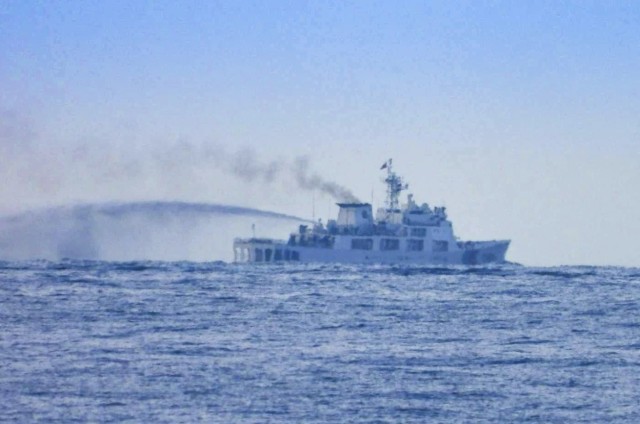
In this photo provided by the Armed forces of the Philippines Public Information Officer, a China Coast Guard vessels conducts apparent water cannon drill close to long-grounded Philippines warship BRP Sierra Madre in the vicinity of Second Thomas Shoal at the disputed South China Sea on Wednesday August 20, 2025.
Australia and the Philippines are stepping up military cooperation as tensions rise in the South China Sea. Defense chiefs from both nations met in Manila on Friday to discuss growing security concerns, particularly over Beijing’s increasing activities in the disputed waters.
Australia’s Defense Chief in Manila
Australian Defense Minister Richard Marles arrived in the Philippines while troops from both countries conduct their largest joint combat drills to date. More than 3,600 personnel are participating in the live-fire exercises, which include battle maneuvers and naval operations.
Marles has also been invited to witness a mock amphibious beach landing, showcasing the deepening military ties between Canberra and Manila. The exercise will take place in a western Philippine town facing the South China Sea.
Exercise Alon: A Display of Firepower
The joint drills, known as Alon—Tagalog for wave—highlight Australia’s expanding military reach in the region. The exercises feature advanced weaponry such as:
- An Australian guided-missile destroyer
- F/A-18 supersonic fighter jets
- A C-130 transport and cargo aircraft
- Javelin anti-tank systems
- Special forces sniper weapons
Officials say the drills aim to strengthen defense readiness and enhance interoperability between the two militaries.
Beijing’s Strong Reaction
China has repeatedly voiced opposition to these combat exercises. Beijing claims nearly the entire South China Sea, a vital global trade route. However, the Philippines, Australia, the U.S., and other allies argue for freedom of navigation and overflight in international waters.
In recent years, Chinese ships and aircraft have confronted U.S., Philippine, and Australian forces in dangerously close encounters, raising fears of escalation. The waterway remains a geopolitical flashpoint, with the risk of a wider conflict involving Washington and its allies.
New Confrontation at Second Thomas Shoal
The timing of the drills coincides with fresh tensions at the Second Thomas Shoal, where Philippine troops maintain an outpost on the grounded warship BRP Sierra Madre.
On Thursday, the Philippine military reported a significant Chinese buildup near the shoal. Several coast guard and suspected militia vessels, supported by speedboats with mounted weapons, a helicopter, and a drone, moved closer to the Sierra Madre.
At one point, a Chinese boat approached within 50 meters of the ship, prompting Filipino forces to intervene. Rear Admiral Roy Trinidad described the situation as alarming, warning of possible escalation. “We have contingency plans in place,” he said.
China Deploys Water Cannons and Barriers
Philippine officials confirmed that one Chinese coast guard ship conducted a water cannon drill at sea. Other vessels laid a net barrier across the entrance to the shoal, a route previously used for resupply missions to the Sierra Madre.
The Philippine military noted that some Chinese fast boats appeared upgraded with heavy-mounted weapons, further intensifying concerns.
U.S. Monitoring the Situation
A Philippine security official revealed that the U.S. military is closely monitoring the developments through aerial surveillance. While details remain undisclosed, the monitoring underscores Washington’s vested interest in maintaining stability in the contested waters.
Scarborough Shoal Collision Escalates Tensions
The latest confrontation follows a serious incident on August 11 at the Scarborough Shoal, another disputed area. Two Chinese vessels—one from the navy and another from the coast guard—collided while attempting to block a Philippine patrol ship.
The impact damaged the bow of the Chinese coast guard ship, and reports suggest possible injuries or crew members being thrown overboard. Despite an offer of medical aid from the Philippine side, China remained unresponsive.
Manila’s Firm Stance
Despite rising tensions, the Philippines maintains a clear position. Rear Admiral Trinidad emphasized that President Ferdinand Marcos Jr.’s directive is firm: “We will not back down from any threat against our sovereignty.”
This statement reflects Manila’s determination to defend its maritime claims, even as Beijing increases pressure.