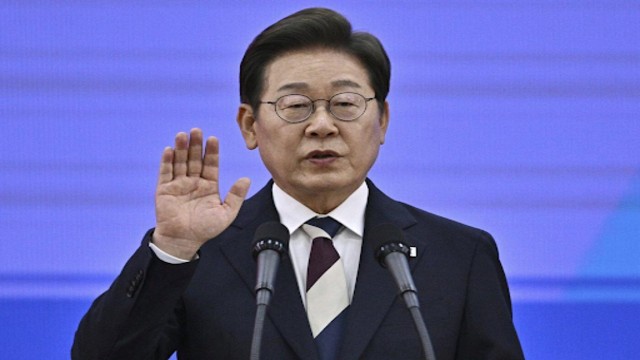
South Korea's newly-elected President Lee Jae-myung takes his oath during his inauguration ceremony at the National Assembly in Seoul, on June 4, 2025. (AP Photo)
In a move set to redefine defence leadership in South Korea, President Lee Jae Myung has nominated a civilian—lawmaker Ahn Gyu-back—as the country’s new defense minister. This marks a major departure from six decades of military-led defense governance.
Civilian Choice Amid Calls for Reform
Ahn, a five-term liberal lawmaker from the Democratic Party, has been a longstanding figure in national defense debates. He has served on the National Assembly’s defense committee and chaired the panel that investigated the controversial martial law declaration, made under former President Yoon Suk Yeol.
President Lee had pledged during his campaign to break away from military dominance in the defense ministry. His decision comes as part of a broader promise to ensure democratic oversight over armed forces following a turbulent chapter in South Korea’s recent history.
Martial Law Fallout Sparks Change
This shift arrives just months after a political crisis gripped the nation. In 2024, former President Yoon deployed heavily armed troops to government offices, including the National Assembly and the election commission. The operation, allegedly intended to suppress political opposition, has since been labelled by prosecutors as an unlawful rebellion.
Yoon now faces rebellion charges and was formally removed from office. Several high-ranking military and defense officials involved in that operation are also under criminal trial. Among them is former Defense Minister Kim Yong Hyun.
The scandal ignited widespread calls for stronger civilian oversight of the military—demands that Lee appears keen to address.
Breaking with a Deeply Ingrained Tradition
South Korea has not had a civilian defense minister since 1961, when a military coup led by Park Chung-hee brought the army firmly into political power. Even after democratization in the late 1980s, the post continued to be held by retired military generals.
Lee’s choice of Ahn breaks this long-standing pattern and signals a shift toward deeper civilian involvement in national defense affairs.
Smooth Appointment Process Expected
While Ahn’s appointment will undergo a legislative hearing, the process is expected to be symbolic. The Democratic Party currently holds a strong majority in the National Assembly, and defense minister appointments do not require parliamentary approval.
Presidential chief of staff Kang Hoon-sik underscored the significance of the appointment, stating, “As the first civilian Minister of National Defense in 64 years, he will lead the military’s transformation after its mobilization in martial law.”
Cabinet Overhaul Continues
Ahn is one of 11 new ministers President Lee announced on Monday. Other key appointees include veteran diplomat Cho Hyun as foreign minister and Chung Dong-young—returning as unification minister. He last held the position between 2004 and 2005 during critical phases of inter-Korean relations.
With these appointments, Lee’s administration is signaling a clear break from the past. This could be a push toward renewed democratic norms in the nation’s security and diplomacy.