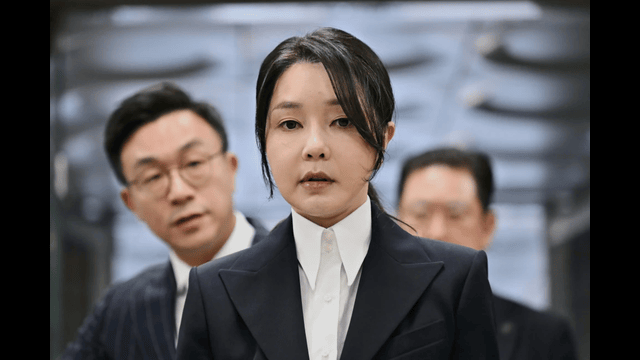
South Korea’s former lady Kin Keon Heo, wife of former president Yoon Suk Yeol, arrives at a court to attend a hearing to review her arrest warrant requested by special prosecutors in Seoul, South Korea, on Aug 12, 2025.
A South Korean court has sentenced former first lady Kim Keon Hee to prison in a high-profile corruption case.
The ruling comes at a politically sensitive moment, ahead of a separate verdict involving former President Yoon Suk Yeol.
The decision has drawn national attention and renewed debate on power, privilege, and accountability in South Korea.
Court Hands Down Prison Term
The Seoul Central District Court sentenced Kim Keon Hee to 20 months in prison on Wednesday.
She was found guilty of accepting gifts linked to improper business favors.
Judges ruled the acts amounted to bribery under South Korean law.
The court said Kim received valuables from figures connected to the Unification Church.
These gifts were allegedly exchanged for influence over business-related matters.
The court concluded this conduct damaged public trust.
Mixed Verdict Surprises Observers
The sentence surprised many legal observers and political analysts.
Independent prosecutors had demanded a much tougher punishment.
They sought a 15-year prison term across multiple charges.
However, the court cleared Kim of several major allegations.
She was acquitted of stock price manipulation charges.
Judges also dismissed claims of illegal political funding.
The court cited insufficient evidence for those accusations.
Only the bribery charge stood firm under judicial scrutiny.
This narrowed the scope of her criminal responsibility.
Defense Reacts to Ruling
Kim’s legal team welcomed parts of the verdict.
They thanked the court for dismissing the more serious charges.
Still, they expressed concern over the length of the sentence.
The lawyers described the 20-month term as relatively high.
They said discussions are underway on whether to file an appeal.
No final decision on an appeal has been announced yet.
Arrest Followed Fears of Evidence Tampering
Kim has remained in custody since August.
The court approved her arrest warrant earlier this year.
Judges cited concerns she could destroy evidence.
Just days before her arrest, Kim issued a public apology.
She said she regretted causing concern among citizens.
Yet she continued to deny key allegations.
Kim also downplayed her role, calling herself insignificant.
Her remarks sparked criticism across political circles.
Many viewed the statement as evasive.
Timing Raises Political Stakes
The verdict arrives weeks before another major ruling.
The same court will soon decide the fate of Yoon Suk Yeol.
He faces charges linked to a short-lived martial law declaration.
Yoon imposed martial law briefly in December 2024.
Prosecutors later accused him of rebellion.
Another independent counsel has sought the death penalty.
Broader Impact of the South Korea Corruption Case
The South Korea corruption case has shaken the political establishment.
It highlights increasing scrutiny of elite misconduct.
Public pressure for transparency remains strong.
Analysts say the ruling may influence upcoming judicial decisions.
It could also affect public confidence in democratic institutions.
For many citizens, accountability now feels closer than before.