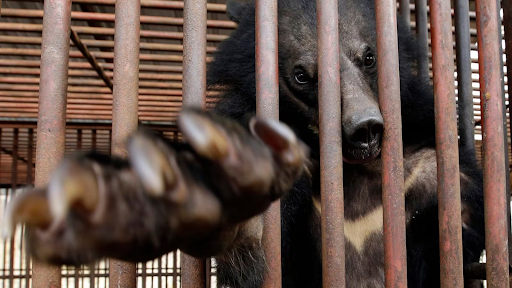
A bear peers out from its cage at a bear farm in Dangjin, South Korea, in a photo taken on Jan. 24, 2014. AP Photo
South Korea will formally bring an end to its long-criticized bear bile farming industry this week. Starting Jan. 1, the country will ban the breeding and possession of bears as well as the extraction of their bile.
The Ministry of Climate, Energy and Environment announced the change on Tuesday, saying it follows updates to the nation’s animal protection laws. The revised law includes prison sentences of up to two or five years for those who break the rules.
Despite the move, about 200 bears still live in small cages across the country, raised mainly for their gall bladders.
Decline of a Once-Common Practice
South Korea remains one of the few countries that has allowed bear bile farming, mainly involving Asiatic black bears, often called moon bears. People have traditionally used bear bile in medicine or food, believing it boosts strength and energy.
Over the past 20 years, demand dropped sharply. Many people questioned the medical value of bile, turned to cheaper treatments, and grew more aware of animal cruelty. Public pressure steadily pushed the government toward change.
The ban stems from a 2022 agreement involving government officials, bear farmers, and animal rights groups. That deal set a goal to fully stop bear bile farming by 2026.
Relocating Bears Remains a Challenge
Animal welfare groups now handle the purchase of bears from farmers, while the government builds and manages sanctuaries. So far this year, workers have moved 21 bears to a government-run facility in the southern Jeolla province.
However, 199 bears still remain on 11 farms. Officials and activists say disagreements over compensation payments continue to slow progress.
The environment ministry plans a six-month grace period. Farmers may keep their bears during this time, but the law will punish anyone who extracts bile. The ministry also plans to offer financial support to farmers who care for their animals until relocation.
“Our plan to end bear farming business is an implementation of our country’s resolve to improve welfare of wild animals and fulfill our related international responsibility,” said Environment Minister Kim Sungwhan. “We will strive to help bears protected until the last one.”
Farmers Express Concern
Some farmers remain unhappy with the policy. Kim KwangSoo, who raises 78 bears in the city of Dangjin, said others sold their bears cheaply because of money troubles.
“This is a very bad policy,” Kim said. “I’ll still observe the law because I’d suffer some disadvantages if I don’t do so.”
Kim said caring for bears has left him with debts worth hundreds of thousands of dollars. His farm once held about 270 bears in 2014, but many were sterilized under government programs. Others died naturally or during fights caused by overcrowding.
Activists Call for More Space
Animal rights groups welcomed the ban but warned that rescue plans fall short. The current sanctuary can hold 49 bears, but activists say safe care requires fewer animals per site. Plans for a second facility were delayed until 2027 after flooding.
Activists now explore options with overseas zoos to house rescued bears.
“It’s really good (for the government) to reflect on bear bile industry and push to end it but it’s regrettable that there aren’t sufficient measures to protect bears,” said Cheon JinKyung of Korea Animal Rights Advocates. “There aren’t place where these bears can stay.”