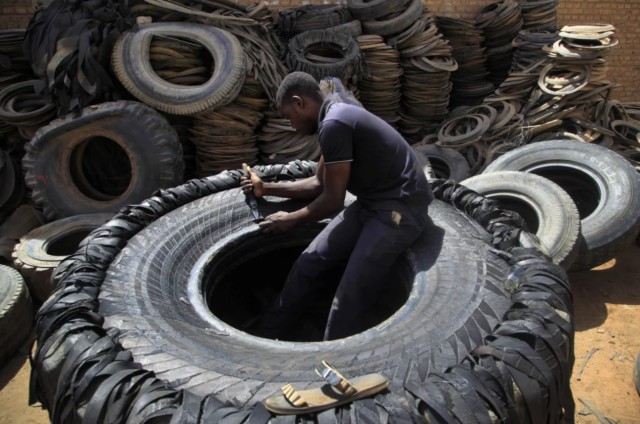
A Sudanese man cuts a heavy-duty machine tire into rubber pieces at a shop in a markeOmdurman, Khartoum, Sudan, May 12, 2014.
In the heart of South Sudan’s deepening economic crisis, local artisans are stepping up with an unexpected solution—shoes made from old tires. With food prices soaring, salaries delayed for months, and unemployment on the rise, many South Sudanese are turning to handmade, affordable footwear crafted from discarded rubber.
These durable sandals and flip-flops are not only cost-effective but have also become a symbol of resilience in a country where poverty and inflation dominate daily life.
South Sudan's Artisans Respond to Rising Demand
In Wau, a bustling town 650 kilometres from the capital, Juba, shoemaker Emmanuel Achuil sits beneath a tarpaulin in the market. With hands stained black from rubber and surrounded by scraps of colourful straps, he crafts each pair of shoes with care and precision.
Achuil now makes up to 10 pairs of tire-sourced footwear each week. Just two years ago, he would see only a handful of customers per month. Today, that number has nearly quadrupled.
He charges around 15,000 South Sudanese pounds per pair—about $4. That price, coupled with durability, makes his shoes an appealing alternative for people who cannot afford imported leather options.
“Even when things get bad—no food, no jobs—jobs-this work doesn’t fail me,” says Achuil. “People always need shoes, especially cheap ones.”
Durable, Functional Footwear for Rural Life
Among Achuil’s growing list of customers is Akol Majok Ring, a cattle herder from Warrap State. He bought his first pair in March and now swears by their performance.
“They’re perfect for cattle grazing,” he explains. “Durable and well-suited for walking long distances.”
Many echo his thoughts. The tire soles grip well on rough terrain, making them ideal for both urban streets and rural landscapes. For most buyers, practicality trumps fashion.
Inflation and Insecurity Deepen the Crisis
South Sudan’s economy has suffered years of decline. Since 2023, the South Sudanese pound has plummeted in value, largely due to disrupted oil exports and ongoing conflict in neighbouring Sudan.
With oil making up 90% of the national budget, any disruption in exports means disaster. Earlier this year, pipeline damage halted exports entirely. Though exports resumed in June after repairs, the economic damage lingers.
Hyperinflation has left nearly 80% of the population below the poverty line. Basic essentials now cost more than many can afford, and formal employment is scarce. Civil servants, teachers, and even soldiers often go months without pay.
In such a setting, tire shoes are no longer just a sign of innovation—they are a necessity.
Skill, Scarcity, and the Struggle for Support
Achuil, who has been making tire-sole shoes since 1996, learned the skill by watching elders in his neighbourhood. Today, he's one of many artisans relying on limited resources to meet growing demand.
However, competition is increasing. With more people entering the trade, raw materials like old tires are harder to find. What used to be free at garages is now a sought-after commodity.
“The government doesn’t support us,” Achuil says. “We need better tools and proper equipment to keep going.”
Dreaming Beyond Survival
Despite the challenges, Achuil has big dreams. He wants to open a workshop, train unemployed youth, and expand his business to other towns. For him, shoemaking is not just about survival—it’s a way to empower others.
“There are many idle youth in Wau,” he says. “If I had the tools and space, I could teach them. This skill can help them survive, just like it helped me.”
As South Sudan continues to face economic instability, the humble tire shoe stands as a powerful example of resilience, resourcefulness, and hope born from hardship.