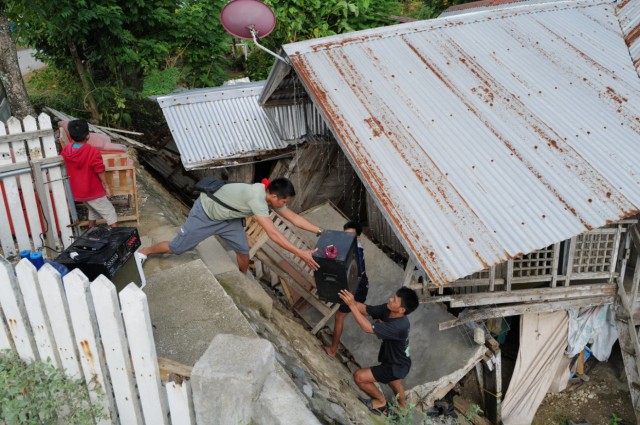
Residents bring out belongings from their earthquake damaged home as they evacuate to safer grounds at Manay town, Davao Oriental province, southern Philippines Saturday, Oct. 11, 2025.
Two powerful earthquakes struck hours apart in the southern Philippines on Friday, leaving at least seven people dead, dozens injured, and communities shaken by landslides and tsunami fears. The first quake, a massive 7.4 magnitude tremor, hit off the coast of Davao de Oro province, causing widespread panic and damage across nearby towns.
Strong Tremors and Immediate Chaos
The initial quake jolted residents late at night, forcing thousands to rush out of their homes and buildings. The shaking was so intense that power lines swayed and electricity went out in several areas.
“I was driving when the ground started to sway. Power lines were shaking, and people ran out screaming,” said Jun Saavedra, a disaster mitigation officer in Governor Generoso town, Davao Oriental.
Officials confirmed that three villagers died in a landslide in a remote gold-mining village in Pantukan, Davao de Oro. Several others were rescued by army troops and volunteers, though many suffered injuries.
Another death was reported in the port city of Davao, where hundreds were treated for bruises, dizziness, and fainting caused by the violent tremors.
Schools and Public Buildings Damaged
The earthquakes damaged several structures, including schools, offices, and parts of Davao City’s international airport. Cracks were visible on walls, but flights continued without interruption.
“We’ve had earthquakes before, but this was the strongest,” Saavedra added. “Some buildings, including a high school, developed cracks. Around 50 students were taken to hospitals with minor injuries.”
Classes were suspended across affected provinces, including Davao Oriental and Manay. In Davao City, with its 5.4 million residents, children were evacuated from schools as aftershocks continued to rattle the area.
Tsunami Scare Triggers Mass Evacuations
The 7.4 magnitude quake prompted tsunami warnings across six coastal provinces. Sirens blared, and thousands of residents living near shorelines fled to higher ground.
According to the Pacific Tsunami Warning Center in Honolulu, small waves were detected along the coasts of the Philippines and Indonesia before the threat was lifted two hours later. Authorities warned, however, that minor sea fluctuations might persist.
In Indonesia’s North Sulawesi province, tsunami waves between 3.5 to 17 centimeters were recorded in several coastal districts, including Melonguane and Beo.
Second Quake Adds to the Panic
Just hours after the first quake, a second powerful tremor hit the same region, further terrifying residents and hampering rescue efforts. Though no additional deaths were reported from the second quake, it deepened existing damage and triggered additional landslides.
Officials said they were still assessing the full extent of the destruction as aftershocks continued to shake the southern provinces.
Philippines’ Long Battle with Natural Disasters
The Philippines, located on the Pacific “Ring of Fire,” frequently experiences earthquakes and volcanic eruptions. The country is still recovering from a 6.9 magnitude quake that struck Cebu province on September 30, killing at least 74 people and displacing thousands.
To make matters worse, the archipelago also faces around 20 typhoons each year, adding to the strain on disaster response systems.
Nearby Quake in Papua New Guinea
On the same day, a 6.0 magnitude earthquake struck off the coast of Papua New Guinea, centered in the Bismarck Sea, about 414 kilometers northeast of Lae. Authorities there reported no casualties or major damage.
Government Response and Relief Efforts
The Office of Civil Defense has mobilized rescue teams, medical support, and temporary shelters for affected residents in Davao de Oro and nearby regions. Officials urged the public to remain vigilant as aftershocks were expected to continue over the weekend.
“The priority is to ensure the safety of residents and assess structural damages,” said deputy administrator Bernardo Rafaelito Alejandro IV. “We are coordinating closely with local authorities for relief and recovery operations.”
Despite the widespread fear, authorities reassured residents that no major tsunami occurred, and most coastal communities had safely returned home by Saturday morning.