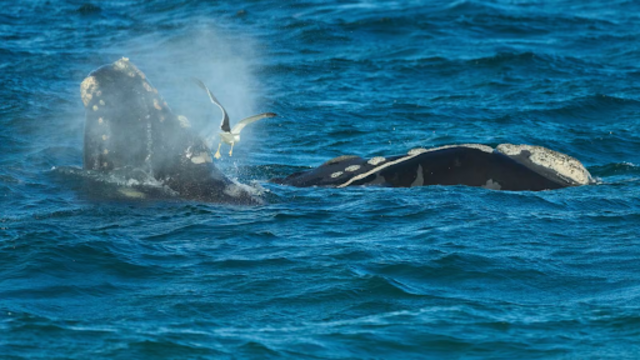
A seagull glides past a Southern right whale calf in the protected El Doradillo area near Puerto Madryn, Argentina, on Saturday, Oct. 4, 2025. CTV
After facing near extinction, Southern right whales have made a remarkable return to the waters of Argentina’s Patagonia. This year, the majestic creatures are appearing in greater numbers off the coast, delighting visitors eager to witness their graceful leaps and tail slaps.
The whales gather mainly around Peninsula Valdés in the Chubut province, one of the most important breeding areas for the species. The peninsula, a UNESCO World Heritage Site, also shelters elephant seals and sea lions, making it a prime destination for wildlife lovers from around the world.
“I’ve seen whales in Canada and California, but this was the best and probably the largest number of whales I’ve ever seen in my life,” said Tino Ventz, a German tourist who visited the area with his girlfriend.
A Species Once on the Brink
Southern right whales were once hunted almost to extinction. Before commercial whaling began, their population was around 100,000 in southern waters. By the time hunting ended in the last century, only about 600 remained.
Now, decades after conservation efforts began, their numbers have grown significantly. Around 4,700 whales are estimated to inhabit the waters near Peninsula Valdés today. This year alone, more than 2,000 whales have been recorded, though experts believe the true figure is even higher.
Tourists Flock to See the Whales
Whale-watching season in Patagonia peaks between August and September, when the animals gather close to shore to breed and nurse their calves. Visitors can view them from boats or even from the beach.
Ventz and his partner joined Argentine tourist Andrea Delfino and her children on a boat tour. Strong southern winds stirred the whales into a playful display, with the giant animals breaching and diving in unison.
Others preferred to watch from land at El Doradillo Park near Puerto Madryn, where whales swim remarkably close to the beach. Agustina Guidolín, a visitor there, called the experience “magical and wild,” saying it fulfilled a lifelong dream.
Scientists Track the Recovery
Researchers continue to monitor the species closely. Biologist Santiago Fernández and his team have conducted aerial surveys of 640 kilometres of coastline since 1999. This year’s count showed 2,100 whales, including 863 mothers with calves.
“In 1999, we counted about 500 whales along that same route,” Fernández said. “We’re now seeing about a three per cent annual growth rate.”
He explained that the actual population is higher because the surveys capture only part of the whales’ migration. Many move to nearby gulfs — San Matías and San Jorge — and even as far north as Buenos Aires province.
A related project, Following Whales, uses satellite tags to track their routes and behaviour. Data show that as calves grow, mothers guide them into deeper waters, areas not covered by the aerial census.
Conservation and Caution
The species’ recovery marks a major conservation success. However, Fernández warned that the growing population faces new dangers from fishing nets and boat traffic. Some whales have suffered injuries that prevent them from returning to Antarctic feeding grounds.
Despite the risks, scientists and tourists alike celebrate the whales’ comeback — a living symbol of resilience in Patagonia’s wild seas.