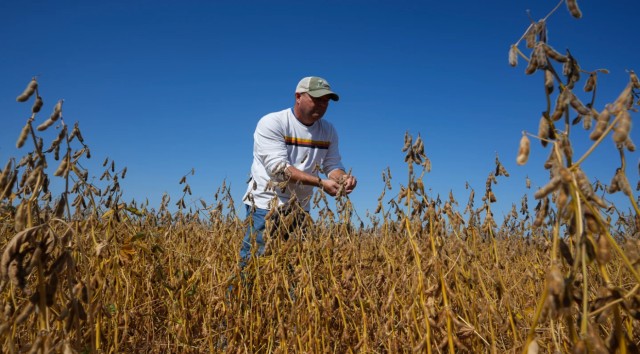
Brian Warpup inspects one of his soybean fields in Warren, Ind., Thursday, Sept. 11, 2025.
Caleb Ragland’s soybean fields in Kentucky are ready for harvest. Yet, instead of celebrating, he is worried. China, once the largest buyer of American soybeans, has stopped purchasing. For soybean farmers across the U.S., this standoff with Beijing has created deep uncertainty about their future.
Beijing’s decision came after President Donald Trump imposed steep tariffs on Chinese goods. In response, China retaliated with tariffs of its own and halted U.S. soybean imports. For farmers, the timing is devastating. Their businesses, built on decades of strong Chinese demand, now face serious risk.
A Blow to America’s Top Export
Soybeans are the leading U.S. agricultural export, representing 14% of all farm goods shipped overseas. Last year, America exported nearly $24.5 billion worth of soybeans, and China purchased more than half of that. The European Union was a distant second.
But in 2025, China has not bought U.S. soybeans since May. Instead, it has turned to Brazil and Argentina. Brazilian soybeans already make up over 70% of China’s imports. With China’s market largely closed, U.S. soybean farmers are left searching for new buyers.
Tariffs Push Farmers to the Edge
China’s tariffs on U.S. soybeans now reach up to 34%, making American crops far more expensive. Farmers have already faced falling crop prices, higher fertilizer and steel costs, and shrinking profit margins.
“This is a five-alarm fire for our industry,” said Ragland, who also heads the American Soybean Association. He and others warn that without a trade breakthrough, many family farms may not survive.
Trump Faces Rising Pressure
Trump still enjoys strong support in rural America, but patience is running thin. Farmers want solutions, not subsidies. In his first term, billions in government aid kept many afloat, but most farmers say they prefer stable markets.
“We don’t want handouts. We want to work and sell our crops,” said Indiana farmer Brian Warpup. Trump has hinted at a new aid package, but soybean farmers stress that only long-term trade deals can secure their future.
Why China Targets Soybeans
China’s strategy is deliberate. Soybeans are critical for animal feed and cooking oil. The U.S. soybean industry grew rapidly as Chinese demand surged in the 1990s. By withholding purchases now, Beijing pressures Washington while strengthening its bargaining power in negotiations.
“China knows farmers are influential in U.S. politics,” said Jim Sutter, CEO of the U.S. Soybean Export Council. “That’s why soybeans are such a target.”
Farmers Diversify, but China Is Irreplaceable
American soybean farmers are scrambling to diversify. Taiwan has pledged to buy $10 billion worth of U.S. farm products, while Japan and Indonesia are showing interest. Growth in biodiesel and research into livestock feed are helping absorb some soybeans at home.
Still, no single market can replace China. “We cannot replace China in one shot,” said Iowa farmer Robb Ewoldt. “It’s not going to happen.”
Farmers’ Message to Trump
Farmers remain loyal but are calling on Trump for action. “We’ve supported you,” Ragland said. “Now we need you to support us.” For many, the survival of their farms — and the hope of passing them to the next generation — depends on a lasting U.S.-China trade agreement.
Until then, soybean farmers remain caught in the middle of a global trade war they cannot control. Their future hinges on negotiations thousands of miles away, while their fields stand ready for harvest.