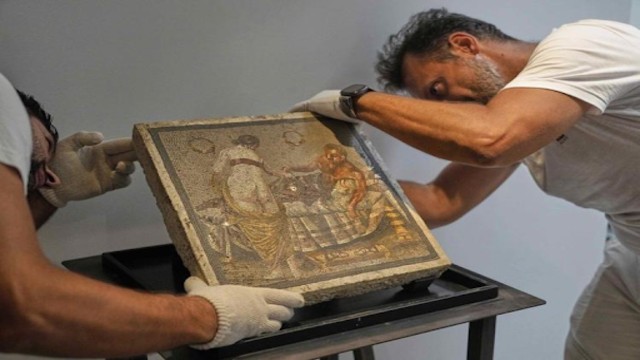
Restorers set on display a Roman mosaic depicting a pair of lovers, which was repatriated from Germany, in Pompeii archaeological park, Italy, Tuesday, July 15, 2025. (AP Photo)
After more than 80 years in Germany, a stolen Roman-era mosaic with an erotic theme has finally come home to Pompeii. Taken during World War II by a Nazi officer, the ancient panel has been returned through diplomatic channels—thanks to a heartfelt gesture by the family who unknowingly inherited it.
The mosaic, crafted between the 2nd century B.C. and the 1st century A.D., had vanished during the chaos of war. It was taken by a Wehrmacht captain stationed in Italy, who later gifted it to a German citizen. That citizen’s heirs, upon discovering its troubled history, reached out to Italy’s cultural heritage unit in Rome to return the piece to its rightful place.
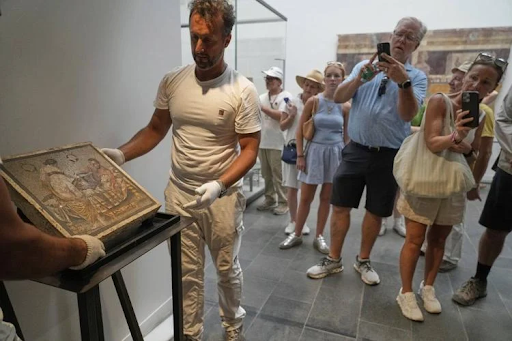
The journey home wasn’t simple. Italian authorities had to verify its origin and authenticity. Once confirmed, the return was facilitated by the Italian Consulate in Stuttgart. The mosaic was officially repatriated in September 2023, and on Tuesday, it found its place at the Archaeological Park of Pompeii.
A Glimpse Into Intimate Roman Life
Experts have hailed the mosaic as a work of “extraordinary cultural interest.” Made from travertine slabs, it captures a rare and intimate portrayal of domestic love in ancient Rome—marking a shift in artistic themes.
Gabriel Zuchtriegel, director of the Archaeological Park and co-author of a recent essay on the panel, explained its significance. “While earlier Roman art glorified mythological passion and heroic figures, this mosaic turns inward—toward love and life within the home.”
Though its exact place of origin in Pompeii remains unclear, researchers managed to trace it to a location near Mount Vesuvius. The eruption of A.D. 79 later buried the entire city under ash, preserving treasures like this one for centuries.
Not Just a Return—A Moral Reckoning
For Zuchtriegel, this return is more than a recovered artifact—it’s a symbol of historical justice. “It’s like healing an open wound,” he said. The mosaic helps us rebuild stories from a time long gone, piecing together how people lived, loved, and expressed intimacy.
What makes this story even more remarkable is the attitude of the heirs. “Returning this piece shows a shift in mindset,” Zuchtriegel noted. The idea of possessing looted art, once seen as a privilege, is now often viewed as a moral burden.
The Pompeii Curse Lives On
Interestingly, the tale echoes a long-standing superstition—the so-called Pompeii curse. For decades, tourists have returned stolen stones and artifacts from the site, claiming they brought misfortune. Letters and packages have arrived from around the world, filled with regrets and returned relics.
While scholars dismiss the idea of a curse, the stories persist. Perhaps, Zuchtriegel mused, the guilt of theft—or the weight of history—carries its own kind of reckoning.
Preserved for the Future
Now safely back in Italy, the mosaic is being catalogued and stored for educational and research purposes. Visitors may one day see it on display, offering a rare window into the private lives of ancient Romans—stories that war tried to erase, but time refused to forget.