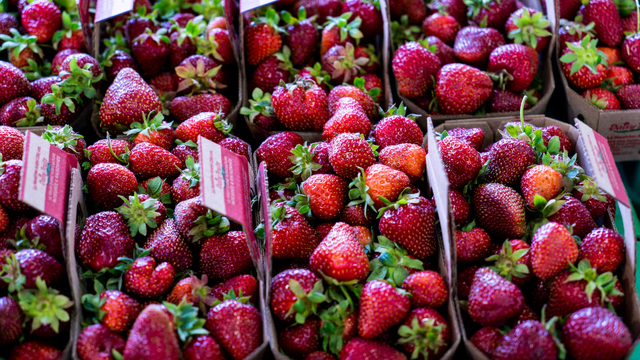
A batch of fresh strawberries is displayed at Jean Talon Market in Montreal on Tuesday, June 16, 2020. The Canadian Press
Strawberry farms across Canada are facing a serious challenge. A fungal disease called Neopestalotiopsis, or “Neo-P,” is spreading quickly and damaging crops. Farmers say there is no cure, and once plants get infected, they become weak and die. The disease can affect every part of the plant, from the leaves to the fruit.
A Farmer’s Struggle
Matthew Compton, who owns Compton’s Farm Market in Summerside, P.E.I., has seen the impact firsthand. He says the disease has already destroyed many of his early strawberry varieties.
“Instead of seeing thick, healthy rows of strawberries,” he said, “I see thin rows with big gaps where plants have died.”
Compton shared that one of his strawberry varieties is completely lost. Another variety, planted across three acres, will produce only half of what it usually does. He expects this to cause a 20 to 25 percent drop in his farm’s income this year.
No Cure, Just Control
Right now, there is no fungicide that can completely kill Neo-P. However, some treatments can help slow the spread. Compton explained, “You can’t get rid of it. You can only keep it from getting worse.”
Health officials have approved one such fungicide for emergency use in eight provinces: Ontario, British Columbia, Alberta, Quebec, New Brunswick, Nova Scotia, Prince Edward Island, and Newfoundland and Labrador.
Where Neo-P Came From
Neo-P was first found in Florida in 2017. Since then, it has shown up in Mexico and several parts of the eastern United States. In Canada, it was first detected in Ontario in 2020.
By 2021, experts in Ontario warned farmers to watch out. They said the fungus had caused serious damage in other countries and could do the same here.
Signs of the Disease
The fungus starts by creating small spots on the leaves. These spots have a light-colored center and a darker border. Over time, the spots grow and become irregular in shape. Eventually, the fruit itself starts to rot and becomes mummified.
Compton says it’s important for farmers to act fast when they spot the symptoms. But even early action can only slow things down. Once a plant is infected, it likely won’t survive.