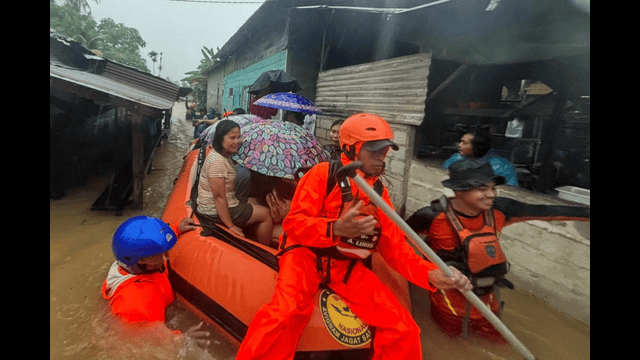
In this photo released by the Indonesian National Search and Rescue Agency (BASARNAS), rescuers on a rubber boat evacuate residents from their flooded home in North Sumatra province, Indonesia Tuesday, Nov. 25, 2025.
Torrential monsoon rains unleashed flash floods and landslides in Sumatra, killing at least 10 people and leaving six missing. The disaster struck multiple districts in North Sumatra province, where swollen rivers and collapsing hillsides sent mud, rocks, and uprooted trees crashing into villages.
Widespread Damage Across North Sumatra
Rescue teams struggled to reach the worst-hit areas after a week of relentless rainfall. Many regions became inaccessible as floods washed out roads and landslides buried key routes.
The National Police reported severe damage across six regencies, where entire neighborhoods were swallowed by mud and debris. Homes, bridges, and public buildings were left in ruins as the force of the water tore through hilly terrain.
Sibolga Becomes the Epicenter of Disaster
The coastal city of Sibolga suffered the heaviest toll. By Wednesday, rescuers had recovered five bodies and found three people injured. Search teams continued to hunt for four villagers still missing in the city.
Sibolga’s police chief, Eddy Inganta, confirmed that six landslides had struck the hilly city, flattening 17 homes and a café. Emergency shelters were quickly set up, and authorities urged residents in high-risk zones to evacuate immediately.
“Bad weather and mudslides hampered the rescue operation,” Inganta said. He added that access to impacted districts remained limited due to dangerous terrain and ongoing rainfall.
Central Tapanuli Faces Heavy Losses
In Central Tapanuli, landslides crushed several homes, killing a family of four. Floodwaters also engulfed nearly 2,000 houses and buildings, leaving thousands displaced.
Residents described terrifying moments as water surged through streets, destroying property and forcing families to flee at night.
Destruction Spreads to Surrounding Districts
Other areas across North Sumatra also reported significant damage:
- In South Tapanuli, falling trees killed one villager and injured another.
- Mandailing Natal lost a major bridge, cutting off key transport lines.
- On Nias island, a main road was blocked by mud and debris, isolating several communities.
- At least 470 houses were submerged across different districts.
Videos circulating on social media showed water pouring off rooftops as terrified residents climbed to higher ground. Streets turned into violent torrents carrying tree trunks, broken structures, and layers of mud.
Rescue Efforts Hampered by Weather and Terrain
With rain still pounding the region, rescue teams faced dangerous working conditions. Mudslides continued to threaten rescuers as they attempted to dig through thick layers of earth.
Authorities warned that continued rainfall could trigger more landslides, prompting urgent evacuation orders in vulnerable areas.
Tragedy Follows Java Disaster Response
Tuesday’s disaster in Sumatra came on the same day Indonesia’s disaster agency declared an end to relief efforts in Central Java. Two districts—Cilacap and Banjarnegara—had been hit by deadly landslides earlier this month.
More than 1,000 rescuers spent ten days searching for victims in Java, where 38 people died from rain-triggered landslides. However, unstable ground and persistent bad weather forced officials to halt operations.
At least two people in Cilacap and 11 in Banjarnegara remain missing, with rescue teams calling further attempts too dangerous.
Seasonal Rains Bring Annual Risk
Indonesia faces heavy monsoon rains from October to March, often triggering deadly floods and landslides. The archipelago’s rugged landscape—home to 17,000 islands and millions living on hillsides or floodplains—makes it one of the world’s most disaster-prone nations.
As the rainy season intensifies, authorities warn that more extreme weather events could strike. Rescue teams remain on high alert as communities across North Sumatra brace for additional flooding in the coming weeks.