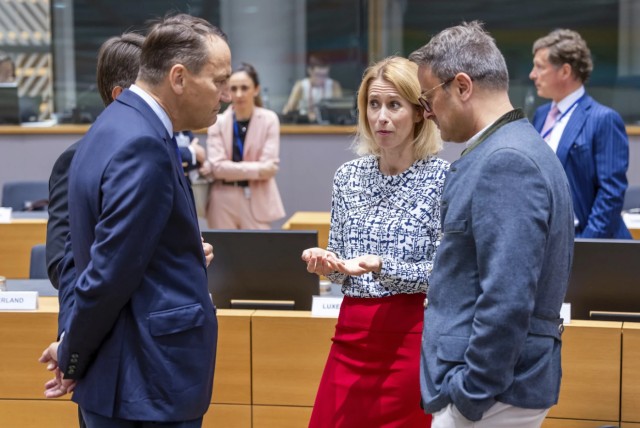
European Union foreign policy chief Kaja Kallas, center, talks with Poland's Foreign Minister Randoslaw Sikorski, left and Luxembourg's Foreign Minister Xavier Bettel, right , during the EU foreign ministers meeting at the EU Council building in Brussels, Tuesday, July 15, 2025.
European leaders and Ukraine are urgently seeking discussions with U.S. President Donald Trump before his meeting with Russian President Vladimir Putin. The summit, set for Friday in Alaska, has raised fears that crucial decisions may be made without Kyiv’s involvement.
Ukrainian President Volodymyr Zelenskyy is not invited to the summit. European leaders are also unlikely to attend. This exclusion has fueled concerns that Trump and Putin could agree to territorial swaps or terms favoring Russia.
Emergency Diplomatic Push
German Chancellor Friedrich Merz has called for a high-level meeting on Wednesday. Attendees are expected to include Trump, U.S. Vice President JD Vance, Zelenskyy, NATO Secretary General Mark Rutte, and leaders from Britain, France, Finland, Italy, and Poland.
The talks will focus on applying pressure on Russia, preparing for possible peace negotiations, and addressing territorial disputes. European Commission President Ursula von der Leyen has confirmed her participation.
Fears Over Land Swaps
Ukraine and its European allies insist that no agreements on land should be made without Ukraine’s consent. They stress that territorial concessions must not be a precondition for peace.
Trump hinted that some form of land swap may be discussed, calling it “good stuff, not bad stuff” for Ukraine. However, he stopped short of confirming his attendance at Merz’s talks, saying only that he wanted “everybody’s ideas” before meeting Putin.
A Coalition for Ukraine’s Defense
A “coalition of the willing” is forming in Europe, ready to deploy troops to Ukraine to enforce any future peace deal. Leaders including French President Emmanuel Macron, U.K. Prime Minister Keir Starmer, and Chancellor Merz will meet Wednesday to coordinate strategies.
Polish Prime Minister Donald Tusk stressed that borders cannot be changed by force. He insisted that all peace terms must involve Ukraine directly.
Reality on the Ground
Since 2022, Russia has illegally annexed four Ukrainian regions—Donetsk, Luhansk, Kherson, and Zaporizhzhia—without full control over them. It also occupies Crimea, seized in 2014.
On the 1,000-kilometer front line, Russia’s larger army has advanced slowly but at great cost. The UN estimates more than 12,000 Ukrainian civilians have died from relentless bombardments.
NATO’s Position
NATO chief Mark Rutte acknowledged that Russia’s control over parts of Ukraine will be a reality in any peace talks. He compared it to the West’s refusal to recognize Soviet control over the Baltic states during the Cold War, despite acknowledging it in practice.
Still, Western leaders reject legal recognition of Russia’s claims. For Zelenskyy, giving up territory without a ceasefire is politically impossible after the loss of so many lives.
Putin’s Possible Goals
Analysts suggest Putin may value a Ukraine with a Russia-friendly government over outright territorial gains. Such a government would be less likely to pursue NATO membership, similar to how pro-Russian enclaves in Georgia have blocked its NATO path.
The Road Ahead
Zelenskyy demands a ceasefire as the first step toward peace. European allies agree, insisting Ukraine alone should decide any future land arrangements. Security guarantees will be a key part of talks, ensuring Ukraine is not left vulnerable to future attacks.
The EU also insists Ukraine must retain the right to join the EU and maintain unrestricted military capabilities. NATO membership, however, has been ruled out for now by the Trump administration.
Europe’s United Front
EU foreign ministers met Monday to plan more sanctions against Russia, increase military aid, and cover Ukraine’s budget needs.
EU foreign policy chief Kaja Kallas emphasized that transatlantic unity is essential. “Support for Ukraine and pressure on Russia is how we end this war,” she said.