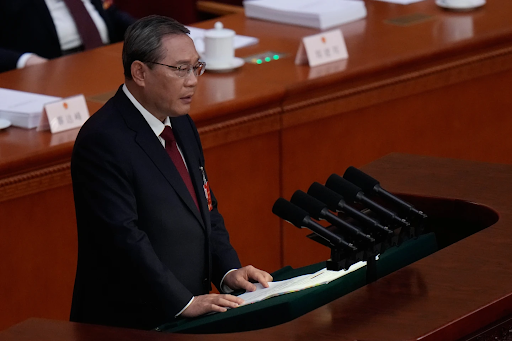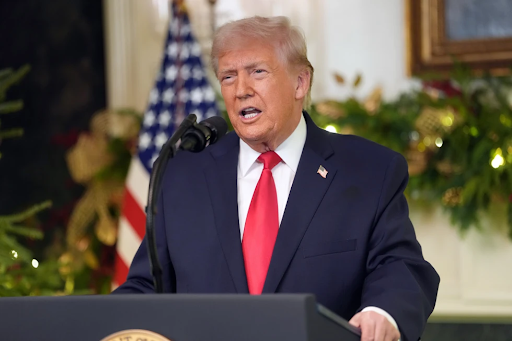
President Donald Trump speaks during an address to the nation from the Diplomatic Reception Room at the White House, Wednesday, Dec. 17, 2025, in Washington.
The United States has approved a massive arms sales package to Taiwan valued at more than $10 billion. The announcement signals a sharp escalation in Washington’s military support for Taipei and is expected to anger Beijing.
The decision comes amid fluctuating U.S.-China relations, shaped by trade disputes and growing pressure on Taiwan’s security.
Arms Sales Announced During Trump Address
The U.S. State Department confirmed the Taiwan arms sales late Wednesday. The timing coincided with a nationally televised address by President Donald Trump.
Trump did not directly mention China or Taiwan during the speech. Foreign policy was largely absent from his remarks.
Despite that silence, the arms package marks one of the largest military approvals for Taiwan in recent years.
What the Taiwan Arms Package Includes
The approved package includes eight separate arms sales agreements. Together, they aim to strengthen Taiwan’s defensive capabilities.
Key components include 82 HIMARS launchers and 420 ATACMS missiles, valued at more than $4 billion. These systems resemble those earlier supplied to Ukraine.
The deal also covers 60 self-propelled howitzers and supporting equipment worth over $4 billion.
Unmanned systems form another major element. The U.S. approved drones valued above $1 billion.
Additional items include military software exceeding $1 billion, Javelin and TOW missiles worth more than $700 million, and helicopter spare parts valued at $96 million.
The package also features Harpoon missile refurbishment kits worth $91 million.
US Justifies Taiwan Arms Sales
In official statements, the State Department said the Taiwan arms sales serve U.S. national, economic, and security interests.
Officials emphasized the goal of helping Taiwan modernize its military while maintaining a credible defensive posture.
The sales are also framed as essential to regional stability, military balance, and long-term economic progress.
Legal Obligations Drive US Policy
Under U.S. federal law, Washington is required to assist Taiwan’s self-defense. That obligation has become increasingly contentious.
China claims Taiwan as its territory and has pledged reunification, by force if necessary.
Beijing views large U.S. arms sales to Taiwan as a direct violation of its sovereignty.
Taiwan Welcomes US Support
Taiwan’s Defense Ministry thanked Washington for the approval. Officials said the weapons would enhance deterrence and strengthen self-defense readiness.
The ministry described Taiwan’s defense buildup as the foundation of regional peace and stability.
Foreign Minister Lin Chia-lung echoed that message. He said U.S. support helps deter conflict in the Taiwan Strait.
Taiwan Boosts Defense Spending
The arms sales align with Taiwan’s pledge to increase defense spending. The government plans to reach 3.3% of GDP next year.
By 2030, defense spending is projected to hit 5% of GDP.
The increase follows pressure from Trump and the Pentagon, who urged Taiwan to spend up to 10% of its GDP on defense.
That demand has sparked debate and resistance within Taiwan’s opposition KMT party.
Major Budget for Taiwan's Dome Defense
President Lai Ching-te recently announced a $40 billion special defense budget.
The funds will support arms purchases and the creation of an advanced air defense network known as Taiwan Dome.
The budget will be distributed over eight years, from 2026 to 2033.
China Condemns US Legislation
The military assistance boost was previewed in the National Defense Authorization Act. Trump is expected to sign it soon.
China’s embassy in Washington strongly criticized the legislation. It accused the U.S. of exaggerating the “China threat.”
Beijing said the bill undermines sovereignty and disrupts bilateral relations.The U.S. Senate passed the bill Wednesday, sealing its path to becoming law.