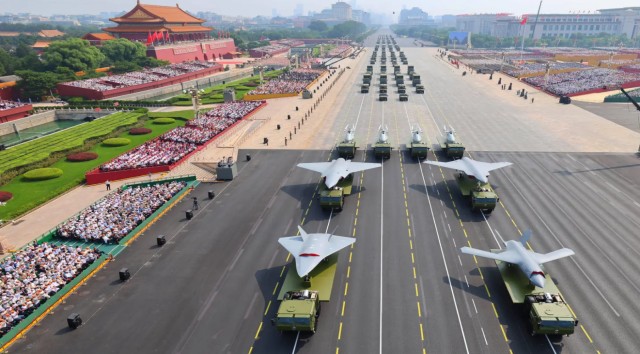
In this photo provided by China’s Xinhua’s News agency, drones and other ornaments pass during the military parade to accommodate the 80th anniversary.
Leaked Russian documents suggest Moscow is supplying China with gear and know-how.
A U.K. defence institute warns the transfers could help prepare an invasion of Taiwan.
What the documents show
Around 800 pages of contracts and equipment lists form the basis of the analysis.
The papers were shared with researchers after publication by the Black Moon hacktivist group.
The Royal United Services Institute (RUSI) analysed the material and published its findings.
RUSI says some files look authentic, though parts may have been redacted or altered.
The Associated Press reviewed selected documents but could not fully verify them.
Military gear and training promised
The documents mention delivery schedules and technical work already under way.
They list light amphibious assault vehicles and airborne armoured personnel carriers.
Also included are anti-tank self-propelled guns and command and observation vehicles.
A price tag in the files totals more than $210 million for listed equipment.
Russia reportedly agreed to supply training in China alongside the hardware.
High-altitude parachutes and longer reach
One system named Dalnolyot is built for extremely high altitude parachute drops.
Documents show tests requested from 8,000 metres and performance down to –60°C.
Drops from that height could let forces glide as far as 80 kilometres.
RUSI warns such reach would allow stealthy insertions from outside local airspace.
Analysts say these parachute capabilities could shorten any invasion planning timeline.
Experience versus equipment
Analysts note the real value lies in training and procedures, not only hardware.
Russia has decades of airborne combat experience that China largely lacks.
Moscow’s combat lessons could accelerate China’s airborne program by years.
But Russia’s parachute operations have not always succeeded, as Ukraine showed.
Failed early attempts to seize key airfields in 2022 remain a cautionary tale.
Strategic motives and wider aims
RUSI suggests Russia wants to deepen military sales to China and fund its war.
Moscow may also seek to distract the United States by drawing it into Taiwan concerns.
Beijing could then reverse-engineer technology and adapt systems for broader uses.
Experts say parachute insertions would likely support logistics, not be the main attack.
The operational challenge for China
To take Taiwan, analysts say Beijing must first suppress Taiwanese air defences.
Then it would need to land enough troops and vehicles fast enough to build strength.
One suggested tactic in the report is airlanding armoured vehicles on golf courses.
Those could open corridors for follow-on forces to move toward ports and airstrips.
Implications and unanswered questions
The papers do not show clear payment or confirmed delivery from China.
Beijing, Moscow and Taipei declined or did not respond to requests for comment.
Still, access to Russian systems and training would materially improve invasion options.
For now, the documents raise a stark question about how fast plans could move.