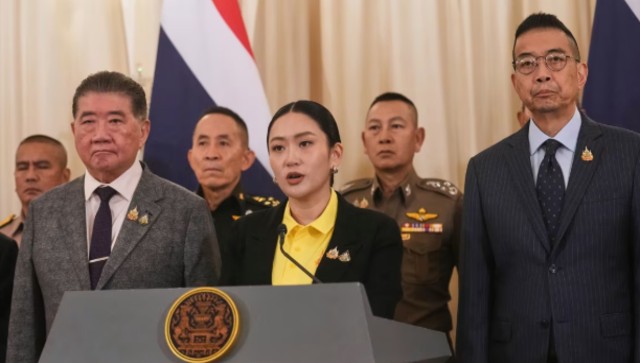
Thailand's Prime Minister Paetongtarn Shinawatra, center, talks to reporters at Government house in Bangkok, Thailand, on June 19, 2025
Thailand is once again on edge. A leaked phone call between Prime Minister Paetongtarn Shinawatra and Cambodia’s former leader Hun Sen has sparked a major political storm. The fallout could topple the Thai government and inflame an already tense border conflict between the neighboring nations.
The leaked 17-minute conversation has drawn national outrage. Paetongtarn, just 10 months into office, appears to criticize her own military over a deadly border clash with Cambodia. Now, her leadership is under threat, and the country's fragile political balance hangs in the balance.
Prime Minister Under Fire Over Cambodia Phone Leak
Paetongtarn Shinawatra, Thailand’s youngest prime minister at 38, is facing demands to resign. In the leaked call, she calls Hun Sen “uncle” and seems to criticize the Thai army’s actions during a recent border skirmish. One Cambodian soldier died in the clash, heightening nationalist anger in both countries.
The call reveals discord within Thailand’s government. Paetongtarn’s remarks suggest her administration and military are at odds—a perception fueling public and political backlash.
Fallout: Coalition Partner Withdraws, Trust Erodes
The impact was swift. The Bhumjaithai party, a major coalition partner, pulled its support from the ruling Pheu Thai party. This blow weakens Paetongtarn’s hold on power and could lead to her resignation or a forced exit.
Critics argue that her remarks in the call, confirmed authentic by both governments, compromised national security. Political expert Thitinan Pongsudhirak says her departure “is a matter of time,” warning that legal consequences could follow.
Government’s Apology and Diplomatic Repercussions
In response, Thailand’s Foreign Ministry summoned Cambodia’s ambassador and lodged a formal protest. The Ministry labeled the leak a “breach of diplomatic etiquette” and accused Cambodia of violating international norms.
Thailand called the leak unacceptable and said it undermined mutual trust. Paetongtarn later apologized publicly, stating the conversation was private and part of a “negotiation tactic,” not a betrayal of the nation.
Hun Sen Admits Leak May Have Come from Cambodia
Hun Sen, who ruled Cambodia for nearly four decades before stepping down in 2023, confirmed he shared the recording with 80 officials. He suggested someone from that circle may have leaked the audio. Later, he published the entire call online, escalating tensions further.
Though no longer prime minister, Hun Sen remains politically powerful and is closely tied to Paetongtarn’s family. He is also the current president of Cambodia’s Senate and a long-time ally of Thaksin Shinawatra, Paetongtarn’s father and former Thai prime minister.
Border Dispute Escalates: Nationalism on the Rise
The leaked phone call comes amid a worsening border crisis. Last month’s deadly skirmish occurred near the Emerald Triangle, where Thailand, Cambodia, and Laos meet. Both nations blamed each other, claiming self-defense.
Following the clash, both sides increased troop presence along the border. Thailand closed checkpoints and threatened utilities to Cambodian border towns. In response, Cambodia halted Thai imports and banned Thai TV shows and films.
The tension has ignited nationalism. In Cambodia, thousands rallied in support of their government. In Thailand, conservatives have called for Paetongtarn’s resignation and even criminal charges.
International Legal Battle Brewing
Cambodia has turned to the United Nations’ International Court of Justice (ICJ), requesting a ruling on the disputed territory. However, Thailand rejects the ICJ’s jurisdiction, arguing that parts of the border were never clearly defined.
Border conflicts between the two countries are not new. In 2011, Thai and Cambodian troops clashed near the 11th-century Preah Vihear temple, killing over 20 people and displacing thousands.
Political Theater or Diplomatic Failure?
At a press conference, Paetongtarn attempted damage control. She described the call as political “theater” and emphasized it was not a statement of allegiance. But her explanation has done little to calm the storm.
With her coalition crumbling and opposition growing, Thailand faces another chapter of political upheaval—sparked by a private conversation that should never have gone public.