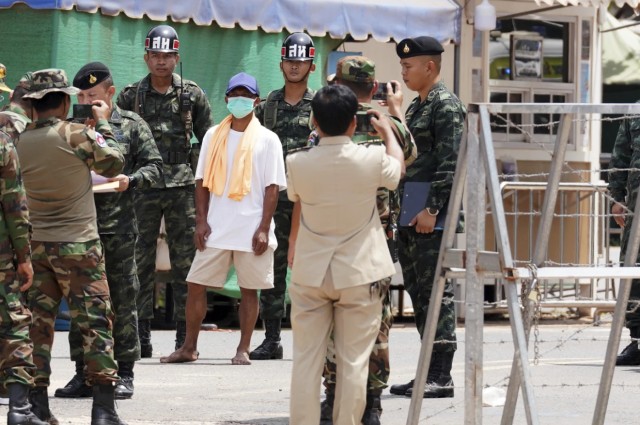
In this photo released by Agence Kampuchea Press (AKP), a Cambodian soldier, center, is escorted by Thai soldiers as he arrives at O Smach, Cambodian-Thai border in Oddar Meanchey province, Cambodia, Friday, Aug. 1, 2025.
Thailand has repatriated two injured Cambodian soldiers amid ongoing friction over a disputed border zone. The move follows a fragile ceasefire after five days of intense fighting between the two Southeast Asian nations.
Two Soldiers Repatriated After Ceasefire
The Cambodian government received the two soldiers on Friday at a border checkpoint linking Thailand’s Surin province with Cambodia’s Oddar Meanchey. One of the soldiers, a sergeant, suffered a broken arm and a hip injury. The other, a second lieutenant, appeared fatigued and in need of family care. Both men pledged not to reengage in conflict with Thailand, according to a statement by Thailand’s 2nd Army Region.
18 Soldiers Still in Thai Custody
Despite returning the injured soldiers, Thailand continues to detain 18 others captured earlier this week. The Cambodian Defense Ministry has demanded their immediate release under international humanitarian law. Thai officials insist they are investigating the group’s actions before making any decision.
Conflicting Narratives on Soldier Capture
The two countries differ sharply on how the soldiers were captured. Cambodia claims the troops approached the Thai military with peaceful intentions, possibly to offer greetings after the ceasefire. Thailand, however, alleges the soldiers crossed into Thai territory with hostile intent.
The lack of neutral, third-party access to the prisoners has only fueled speculation and mistrust. No independent interviews or verifications have been conducted so far.
Cambodia Alleges Torture, Seeks UN Probe
In a new twist, the Cambodian Human Rights Committee has written to the UN High Commissioner for Human Rights. The letter accuses Thailand of torturing the captured soldiers and denying them medical treatment. Cambodia has called for a UN-led impartial investigation. However, the letter offers no concrete evidence to support its claims.
Border Tours and Blame Games
On the same day, both nations led foreign diplomats and observers through the affected border regions. Each side showcased damage allegedly caused by the other, further fueling the blame game. Both governments accuse each other of attacking civilians and violating international war protocols.
More than 36 people have died in the conflict, which featured ground combat, artillery duels, and Cambodian rocket fire. Thailand responded with airstrikes. Over 260,000 people have been displaced due to the violence.
Talks Planned, But Core Dispute Remains
As part of the ceasefire terms, military officials from both sides are expected to meet next week. These discussions aim to prevent future clashes. However, they will not address the core issue—the unresolved territorial dispute that has strained relations for decades.
Digital War and Media Misinformation
The conflict has also spread online. Both nations accuse each other of spreading fake news and conducting cyberattacks. Thailand has gone as far as accusing Cambodia of malicious hacking. Professional journalism bodies in both countries have also clashed, accusing each other of propaganda and misinformation.
Tensions Persist Despite Ceasefire
While the return of the wounded soldiers marks a step forward, the broader crisis remains unresolved. With 18 soldiers still in custody and bitter accusations flying on both sides, the path to lasting peace remains uncertain.
The international community will watch closely next week as military talks resume—hoping diplomacy can succeed where violence has failed.