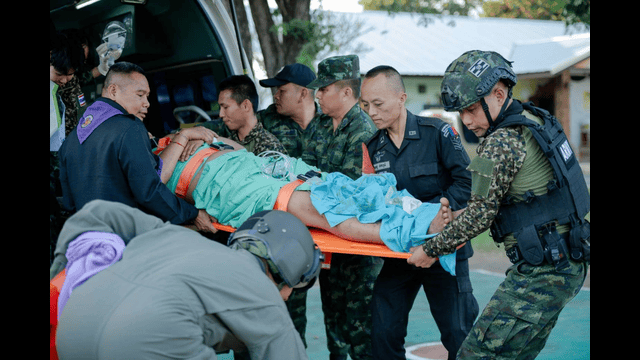
In this photo released by Royal Thai Army, a wounded Thai soldier is carried to be transferred to a hospital in Sisaket province, Thailand, Sunday, Dec. 7, 2025, after, according to a Thai army spokesperson, Cambodian troops fired into Thai territory.
Tensions flared again along the Thailand–Cambodia border on Monday after new clashes erupted, prompting Thailand to launch airstrikes targeting Cambodian military positions. The renewed fighting follows weeks of strain on a fragile ceasefire that both sides had pledged to uphold.
Ceasefire Strained After Land Mine Incident
The truce began unraveling in early November when several Thai soldiers were injured by land mines in disputed territory. Thailand responded by suspending its participation in the ceasefire agreement indefinitely.
Both countries accused each other of violating the terms of the pact, even though they were supposed to coordinate landmine removal efforts.
Sunday Clash Sparks New Escalation
Fresh violence broke out on Sunday along the border, with both nations insisting the other fired first. The Thai army claimed Cambodian forces opened fire and injured two Thai soldiers, sparking a 20-minute exchange.
Cambodia rejected the accusation, asserting that Thailand initiated the confrontation and that its troops did not retaliate.
Thailand Launches Airstrikes After Monday Attack
On Monday, Thai Army spokesperson Maj. Gen. Winthai Suvaree announced that Cambodian troops had again fired into Thai territory in multiple areas.
He said:
- One Thai soldier was killed
- Four others were wounded
- Civilians in the affected region were being evacuated
Thailand responded with airstrikes, targeting what it described as Cambodian “supporting fire positions” along the border.
Cambodia, however, disputed this account. Defense Ministry spokesperson Maly Socheata said Thailand attacked first and claimed Cambodian troops did not retaliate during the initial airstrikes. She urged Thailand to “immediately stop all hostile activities that threaten peace and stability in the region.”
Regional Calls for Calm
Malaysia’s Prime Minister Anwar Ibrahim weighed in, urging restraint and offering support to prevent further violence.
He warned that Southeast Asia cannot afford for “long-standing disputes to slip into cycles of confrontation.”
His call highlighted concerns that the Thailand–Cambodia border conflict could destabilize a region already navigating political and economic challenges.
Centuries of Rivalry Fuel the Dispute
Tensions between Thailand and Cambodia trace back centuries to the era of competing empires. The current territorial dispute is rooted in a 1907 map created during French colonial rule in Cambodia, which Thailand argues is inaccurate.
A major flashpoint is the area surrounding the 1,000-year-old Preah Vihear temple. The International Court of Justice ruled in 1962 that the land belonged to Cambodia, a decision that remains deeply unpopular among many Thais.
Despite modern diplomatic efforts, the ceasefire agreement does not address the fundamental issue — the unresolved question of where the border should be drawn. This unresolved core dispute continues to fuel periodic violence.
Outlook: Ceasefire Under Severe Pressure
Monday’s airstrikes mark one of the most serious escalations since the ceasefire was announced. With casualties rising and both nations accusing each other of aggression, the stability of the border region remains uncertain.
Calls for de-escalation continue, but without a clear mechanism to resolve the territorial disagreement, the risk of further clashes remains high.
The Thailand–Cambodia border dispute, shaped by deep historical grievances and unresolved borders, is once again testing the limits of regional diplomacy.