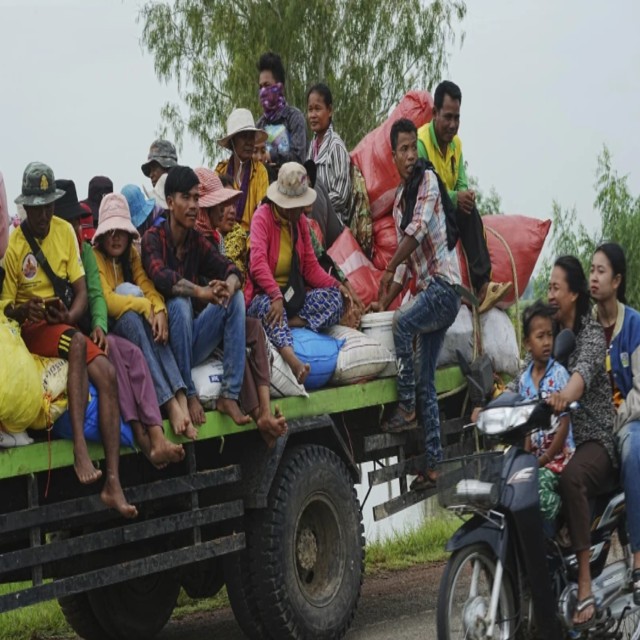
Cambodians sit on a cart of a tractor as they take refuge in Oddar Meanchey province, Cambodia, Saturday, July 26, 2025.
Thousands of civilians have been forced to flee their homes as a violent border conflict between Thailand and Cambodia entered its third day. With the death toll rising to 32 and artillery shelling echoing across villages, fear and uncertainty grip the region.
Civilians Caught in the Crossfire
More than 58,000 people in Thailand have evacuated from border provinces, while over 23,000 Cambodians have also fled danger zones. Makeshift shelters, university gyms, and remote temples have turned into refugee centers. Families, including the elderly and children, are living in temporary camps under plastic tents or tarpaulin-covered bunkers.
Evacuees recall the horror. Pornpan Sooksai, a Thai seamstress, described rushing to safety with her cats. “Boom, boom — the shelling started. We just ran,” she said. Another refugee, Rattana Meeying, who lived through the 2011 conflict, said this time felt worse. “Children and old people were hit without warning.”
Intense Fighting Near Disputed Temple
Clashes broke out near the ancient Ta Muen Thom temple, claimed by both nations. Artillery fire and rocket attacks shattered the early morning peace. Thailand’s army reported that Cambodian troops used BM-21 rocket launchers and heavy artillery. Thai forces responded with what they called “appropriate supporting fire.”
Injured soldiers were seen arriving at hospitals near the conflict zone. Phanom Dong Rak Hospital in Sisaket suffered damage when shells exploded nearby. Windows shattered and roofs were torn apart, even as medical staff treated wounded soldiers — one had both legs severed.
Political Reactions and Accusations
Thailand’s acting Prime Minister Phumtham Wechayachai accused Cambodia of possible war crimes, citing civilian casualties and hospital damage. He insisted that Thailand had shown restraint despite “provocations and aggression.”
Cambodia rejected the claims. Ambassador Chhea Keo, speaking at a United Nations emergency session, asked, “How could a small country with no air force attack a larger one with triple the army?” He emphasized Cambodia’s call for an unconditional ceasefire and a peaceful solution.
ASEAN and the U.N. Urge Calm
The U.N. Security Council held a closed-door meeting to address the escalating Thailand-Cambodia border conflict. Although no official statement was released, diplomats confirmed all 15 members urged de-escalation and dialogue.
Malaysia, chairing the ASEAN bloc, stepped in to mediate. Prime Minister Anwar Ibrahim announced that both nations had agreed to a ceasefire and military withdrawal — though no timeline was given. He called for peaceful talks and offered Malaysia’s support in facilitating negotiations.
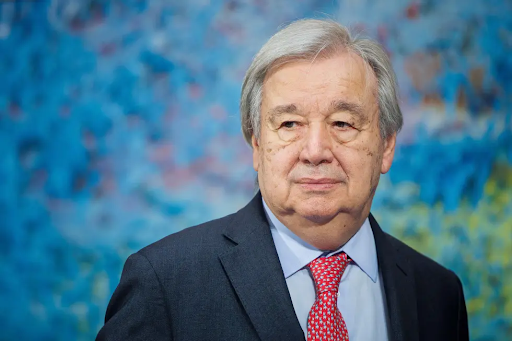
U.N. Secretary-General Antonio Guterres echoed the sentiment. “Both sides must show restraint,” said U.N. spokesman Farhan Haq, urging diplomacy over violence.
Disputed Border at the Heart of Tensions
The Thailand-Cambodia border spans 800 kilometers and has long been a source of friction. The current clashes trace back to May, when a Cambodian soldier was killed in a confrontation. That incident strained relations and stirred political unrest within Thailand.
The conflict intensified on Wednesday when a land mine wounded five Thai soldiers. In response, Bangkok sealed the border and expelled Cambodia’s ambassador. The following day, full-scale hostilities erupted.
Villages on both sides have emptied out. In Cambodia’s Oddar Meanchey province, homes are locked, streets deserted. Families used makeshift tractors to evacuate, while others stayed behind, hoping the shelling would stop.
Hope for a Peaceful End
Among the chaos, voices like 74-year-old Veng Chin from Cambodia plead for peace. “Let us go back to our farms,” he said from a temple shelter. “Please, settle this.”
While diplomacy is gaining momentum, fears of a prolonged conflict still loom. With lives lost, homes destroyed, and tension still high, the Thailand-Cambodia border conflict demands urgent resolution.
Peace must prevail — for the sake of the innocent caught in the middle.