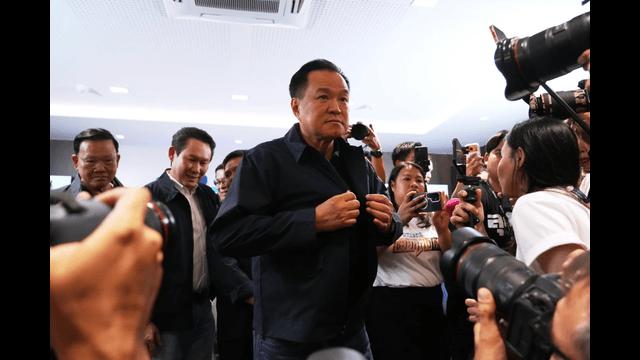
Thailand’s Prime Minister and leader of Bhumjaithai Party Anutin Charnirakul, centre, leaves after a press conference at the party headquarters following the general election in Bangkok, Sunday.
Thailand’s political landscape appears set for a conservative turn after the ruling Bhumjaithai Party emerged as the clear frontrunner in the general election.
Unofficial results released by the Election Commission showed the party leading comfortably as counting neared completion nationwide.
With results reported from around 94 percent of polling stations by Monday, the Bhumjaithai Party of Prime Minister Anutin Charnvirakul was projected to secure the largest share of seats.
The outcome marks the strongest showing for a conservative party in Thailand in several years.
The election unfolded against a challenging national backdrop.
Economic growth has remained sluggish, while nationalist sentiment intensified in recent months.
Voter turnout stood at roughly 65 percent, notably lower than participation in the 2023 election.
Seat Count Signals Clear Advantage
According to the commission’s running tally, Bhumjaithai is expected to win about 193 seats in the 500-member House of Representatives.
That places the party well ahead of its nearest rivals, though short of an outright majority.
Thailand’s lower house consists of 400 constituency-based lawmakers and 100 party-list members.
Party-list seats are distributed based on proportional votes cast for political parties nationwide.
To elect a prime minister, a coalition must control at least 251 seats.
The numbers suggest Bhumjaithai will need one or two partners to form a governing alliance.
Anutin is expected to retain the premiership if negotiations succeed.
People’s Party Strong in Urban Areas
The progressive People’s Party, once widely tipped to lead the race, finished second overall.
It secured 118 seats, driven largely by a strong urban performance.
The party swept all constituencies in Bangkok and dominated several neighboring provinces.
It also topped the party-list vote, collecting about 3.8 million more list ballots than Bhumjaithai.
Despite that showing, the People’s Party struggled to translate urban dominance into nationwide gains.
Rural and provincial constituencies proved more favorable to conservative forces.
Pheu Thai Faces Disappointing Result
Pheu Thai, long a heavyweight in Thai politics, trailed with just 74 seats.
The populist party is closely linked to former prime minister Thaksin Shinawatra.
The result represents a significant setback for a party that has historically performed strongly at the polls.
Analysts described the outcome as underwhelming for Pheu Thai’s extensive political machine.
Even so, it is widely expected to consider joining a Bhumjaithai-led coalition if invited.
Such an alliance could provide the stability needed to form the next government.
Anutin’s Path Back to Power
Anutin has served as prime minister since September, following the removal of his predecessor, Paetongtarn Shinawatra.
Paetongtarn was forced from office over an ethics violation tied to handling relations with Cambodia.
Facing a looming no-confidence vote, Anutin dissolved Parliament in December and called for fresh elections.
Soon after, border tensions with Cambodia reshaped the political narrative.
The clashes allowed Anutin to present himself as a decisive national leader.
This came after earlier criticism over flood responses and financial controversies had dented his popularity.
His campaign emphasized national security, economic stimulus, and political stability.
Those themes resonated beyond Bangkok, particularly in provincial regions.
Conservative Strategy Pays Off
Political analysts say the result, while surprising to some, reflects effective conservative organizing.
Napon Jatusripitak of Thailand Future noted that Bhumjaithai leveraged traditional patronage networks outside major cities.
The party positioned itself as a home for influential local politicians.
It also coordinated closely with provincial allies to avoid splitting conservative votes.
According to Napon, the election may ease a long-running tension in Thai politics.
Conservative forces have often intervened outside elections after losing at the ballot box.
Whether this configuration delivers lasting political stability remains uncertain.
Voters Back Constitutional Reform Process
Sunday’s vote also included a nationwide referendum on constitutional reform.
Voters were asked whether Parliament should begin drafting a new constitution.
The referendum did not involve a specific draft.
Instead, it sought approval to start a lengthy formal drafting process.
Around 60 percent voted in favor, offering a clear mandate to move forward.
The result signals public appetite for change within Thailand’s political framework.
As coalition talks begin, the election outcome suggests a decisive, though cautious, conservative comeback.