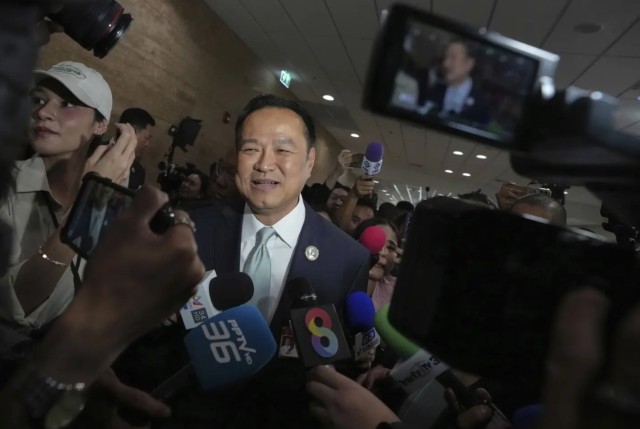
Leader of the Bhumjai Thai Party Anutin Chamvirakul leaves after a press conference at Parliament in Bangkok, Thailand, Wednesday, Sept 3, 2025.
Thai lawmakers will gather on Friday to elect a new prime minister, hoping to end the country’s ongoing political turmoil. Competing parties are promising to dissolve Parliament and call early elections as a way forward.
Five Candidates Eligible for the Top Job
Only five candidates, nominated during the 2023 general election, remain eligible under constitutional rules. Among them, Anutin Charnvirakul, leader of the Bhumjaithai Party, is seen as the frontrunner. His chances strengthened after recent setbacks for the ruling Pheu Thai Party.
Pheu Thai Faces Major Setbacks
Last week, the Constitutional Court disqualified Paetongtarn Shinawatra, Pheu Thai’s candidate and daughter of former Prime Minister Thaksin Shinawatra. She was accused of breaching ethics laws following a controversial call with Cambodian Senate President Hun Sen over border tensions. That dispute sparked a deadly five-day conflict in July.
Following her dismissal, Pheu Thai, currently leading a caretaker government, attempted to dissolve Parliament. However, the king’s Privy Council rejected the move. Left with limited options, the party announced it would nominate its only remaining candidate, Chaikasem Nitisiri, a former Attorney General and Justice Minister.
Chaikasem promised that if elected, he would dissolve Parliament immediately after his inaugural speech.
Anutin Gains Momentum
Anutin has claimed strong backing. He secured 146 votes from his party and allies, while the People’s Party pledged 143 votes in his favor. This easily surpasses the 247-seat majority required in the 492-member House.
At 58, Anutin is a familiar face in Thai politics. He previously served under both the Pheu Thai-led coalition and the military-backed government of Prayuth Chan-ocha. His most notable achievement is the decriminalization of cannabis, a reform now under tighter regulation. He also played a central role as health minister during the COVID-19 pandemic, though he was criticized for delays in vaccine procurement.
Early Election Promises
If Anutin becomes prime minister, his party has pledged to dissolve Parliament within four months. This promise is seen as a bargaining chip to gain broader support. However, the People’s Party stated it will stay in opposition, which could leave Anutin leading a minority government.
The People’s Party also demanded a referendum on drafting a new constitution. The current charter, introduced under military rule, has long been criticized as undemocratic.
People’s Party Pushes for Reform
The People’s Party, previously known as the Move Forward Party, won the most seats in the 2023 election. However, it was blocked from forming a government after the Senate opposed its candidate due to proposals for monarchy reform.
That episode highlighted the influence of the military-appointed Senate, which no longer has a role in choosing Thailand’s prime minister.
A Cycle of Short-Lived Prime Ministers
Thailand has seen a rapid turnover in leadership. After Move Forward was sidelined, Pheu Thai’s candidate Srettha Thavisin briefly held the office but was removed by the Constitutional Court for ethics violations.
He was replaced by Paetongtarn Shinawatra, who also lasted only a year before her dismissal. Her government was further weakened when Anutin’s Bhumjaithai Party withdrew from her coalition following her controversial call with Hun Sen. That exit left Pheu Thai clinging to a fragile majority.
What Comes Next
The upcoming vote will decide whether Anutin secures the top position or Pheu Thai’s last candidate, Chaikasem, manages an upset. Regardless of the outcome, Thailand appears headed toward another election, as both leading candidates promise to dissolve Parliament soon after taking power.
The result will not only shape the next government but also determine whether the push for constitutional reform gains fresh momentum.