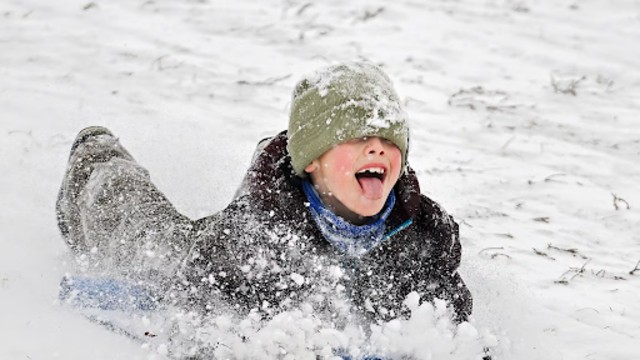
Edouard Piraux slides down a hill in Montreal, Saturday, Dec. 13, 2025. The Canadian Press
Tobogganing, a winter pastime enjoyed by families across Canada, may carry greater risks for children than many parents realize, according to new research from McMaster Children’s Hospital in Hamilton.
A hospital-led study has found that head injuries are the most common harm sustained by children while sledding, prompting renewed calls from pediatric specialists for helmet use and safer sledding practices.
Head injuries dominate sledding-related emergencies
Doctors at McMaster Children’s Hospital say they have treated a growing number of children injured while tobogganing, with head trauma standing out as the most frequent and concerning injury.
In January alone, several children were admitted after sledding into trees and fixed objects, resulting in serious injuries that required trauma-level care.
“Kids are essentially travelling downhill at high speeds with no head protection,” said Dr. April Kam, head of pediatric emergency medicine at the hospital. “When they crash, the head often takes the impact.”
The study found that collisions — either from falling off sleds or striking trees, fences, or other obstacles — were responsible for most injuries. While broken bones, bruises and scrapes were common, injuries involving the head posed the greatest long-term risk.
Why doctors are especially concerned
Researchers emphasized that head injuries in children can lead to lasting neurological effects, including cognitive difficulties and brain damage.
“These aren’t just bumps and bruises,” the study noted. “Head injuries can have lifelong consequences.”
Dr. Kam compared sledding injuries to high-speed trauma scenarios, noting that children often arrive at the emergency department with injuries similar to those seen in serious vehicle collisions.
“We see concussions, skull fractures, brain bleeds, and internal organ injuries,” she said.
Pandemic surge revealed safety gaps
The study analyzed medical records from 243 children aged newborn to 17 who were treated for sledding-related injuries between 2018 and 2022.
Before the COVID-19 pandemic, McMaster Children’s Hospital recorded 62 sledding injuries. During and after lockdowns — when organized sports were cancelled and outdoor play surged — that number jumped to 187 cases.
Although overall injury rates have since returned to pre-pandemic levels, head injuries remain the most common sledding-related injury treated in the emergency department.
The study also found that more children required surgery during the pandemic period, rising from roughly one-third of cases before COVID-19 to nearly 60 per cent afterward.
Children aged 6 to 10 most at risk
The research identified children between the ages of six and 10 as the most vulnerable group, accounting for the highest proportion of injuries. The average age of injured children was just over eight years.
Boys represented slightly more than half of the injured patients, a pattern consistent with previous studies on winter sports injuries.
“These findings line up with what we see clinically every winter,” the researchers said.
Helmets urged, not sled bans
Despite the alarming findings, doctors are not advising families to stop sledding altogether.
Tobogganing, they say, offers important physical, mental and social benefits for children, particularly during the winter months.
Instead, physicians are urging better safety practices — especially helmet use.
“Helmets are routine for skiing and snowboarding now,” Dr. Kam said. “There’s no reason sledding shouldn’t follow the same standard.”
Safety advice for families
The Canadian Paediatric Society recommends that children wear ski or hockey helmets while sledding. Bicycle helmets are discouraged, as they are not designed for cold temperatures or repeated impacts.
Additional safety recommendations include:
- Using designated toboggan hills
- Avoiding hills near roads, trees or fences
- Sitting or kneeling on sleds instead of lying down
- Supervising younger children closely
“Simple changes can significantly reduce the risk of serious injury,” Dr. Kam said.
As winter activities continue across the country, researchers hope the study encourages parents to rethink sledding safety — before a fun day in the snow turns into an emergency room visit.