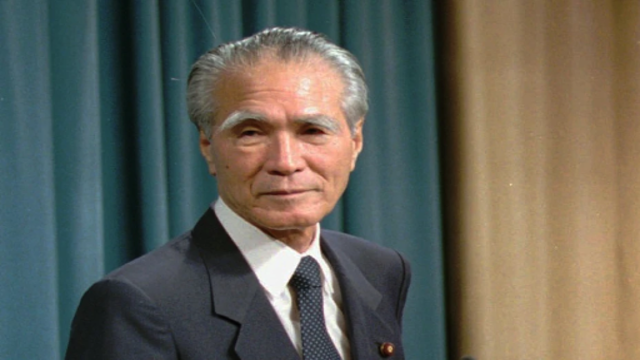
Japan’s Former Prime minister Tomiichi Murayama stands before reports prior to this statement of war remorse at the Prime Minister's Official residence in Tokyo.
Japan mourns the death of former Prime Minister Tomiichi Murayama, a leader remembered for his historic apology over Japan’s wartime aggression. Murayama, who served as Japan’s prime minister from 1994 to 1996, passed away on Friday at the age of 101 in his hometown of Oita, southwestern Japan. The news was confirmed by Mizuho Fukushima, head of the Social Democratic Party.
The Leader Who Confronted Japan’s Wartime Past
Tomiichi Murayama’s name became synonymous with the “Murayama Statement”, an unprecedented act of political courage and humility. On August 15, 1995, marking the 50th anniversary of Japan’s surrender in World War II, Murayama publicly apologized for Japan’s colonial rule and aggression across Asia.
He declared that Japan had “caused tremendous damage and suffering to the people of many countries,” especially in Asia. Murayama expressed “deep remorse” and offered his heartfelt apology, emphasizing that such mistakes must never be repeated.
This statement became the moral foundation of Japan’s postwar diplomacy, symbolizing accountability and peace. For nearly two decades, successive Japanese leaders upheld this stance, making it a cornerstone of Japan’s relationship with its Asian neighbors.
A Career Built on Principle
Before entering national politics, Murayama began his career as a labor union leader and local assembly member. He was elected to parliament in 1972 as a member of the Japan Socialist Party. In 1994, he unexpectedly rose to become prime minister, leading a rare coalition government that included both his Socialist Party and the long-dominant Liberal Democratic Party (LDP).
Murayama’s leadership was marked by a willingness to challenge old party doctrines. In a bold move, he acknowledged the Japan-U.S. security alliance and the Self-Defense Forces as constitutional — a position long opposed by his own party. His decision earned him both respect and criticism, showing his commitment to national stability over party politics.
Challenges of Leadership and Crisis
Murayama’s tenure was far from easy. In 1995, Japan was struck by two national tragedies — the Great Hanshin Earthquake in Kobe and the Tokyo subway sarin gas attack by the Aum Shinrikyo cult.
The earthquake killed more than 6,400 people, while the gas attack claimed 13 lives and injured over 6,000. Murayama faced intense scrutiny for what many viewed as a slow and inadequate government response. Despite this, he maintained humility and accepted responsibility, a reflection of his character and leadership style.
In early 1996, shortly after New Year’s, Murayama surprised the nation by announcing his resignation. He said he had accomplished his mission during a year that marked the 50th anniversary of World War II’s end. His decision, he later said, came while “looking at the blue sky of the new year.”
A Voice of Conscience After Retirement
Even after retiring from politics in 2000, Murayama continued to influence Japan’s national discourse. He frequently criticized nationalist leaders who attempted to downplay or revise Japan’s wartime history.
When later prime ministers distanced themselves from the “Murayama Statement,” he spoke out firmly. He condemned efforts to justify Japan’s military actions or deny the suffering inflicted upon Asian nations.
In 2020, Murayama declared that any claim portraying Japan’s war as “justice or liberation” was “absolutely unacceptable” to Asia and the world. He also pushed for Japan to acknowledge the government’s role in forcing Asian women into sexual slavery during the war.
Legacy of Remorse and Reconciliation
Murayama’s vision extended beyond apology — it was rooted in the belief that peace required honest reflection and regional friendship. He often emphasized building long-term trust with China and other Asian nations, urging cooperation in politics, economics, and culture.
His Murayama Statement remains a moral benchmark for Japanese diplomacy and a reminder of the power of accountability in leadership.
As Japan reflects on the passing of its conscience-driven statesman, Tomiichi Murayama leaves behind a legacy defined by courage, humility, and an unwavering pursuit of peace.