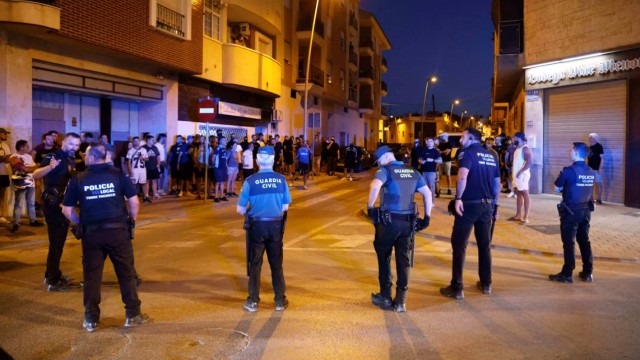
Local Police and Guardia Civil officers during riots in Torre-Pacheco.
Torre Pacheco, a town in southeastern Spain, witnessed violent unrest for three consecutive nights. The clashes erupted between far-right groups and North African migrants, leading to eight arrests. Tensions have risen sharply, echoing Spain’s past struggles with migration-related violence.
Sparked by an Alleged Assault
The unrest followed an alleged assault on a man in his late 60s. Identified as Domingo Tomas by Spanish media, the man said he was attacked while walking through a cemetery garden. He recounted that two unidentified men approached him, speaking an unfamiliar language, before one of them violently knocked him to the ground and fled.
The incident left Tomas injured and recovering at home. The shocking nature of the attack quickly spread across Torre Pacheco, fuelling public anger and triggering street violence.
Riots Break Out in Torre Pacheco
Over the weekend, dozens of masked youths clashed with riot police. They hurled glass bottles and debris, prompting law enforcement to fire rubber bullets to disperse the crowds. Reuters journalists on the ground described the scene as one of Spain’s worst migration-related flare-ups in recent years.
The Spanish Interior Ministry confirmed the arrest of eight individuals. Two foreigners were detained in connection with the assault on Tomas, while the remaining six – including five Spaniards and one North African – were charged with hate crimes, public disorder, and property damage.
Migration in Torre Pacheco: A Community on Edge
Migrants, many of whom are second-generation, account for about one-third of Torre Pacheco’s 40,000 residents. The town and surrounding areas host large numbers of migrant day laborers, particularly in agriculture, a key industry in the Murcia region.
Local mayor Pedro Angel Roca urged calm and caution. “I ask the migrant community not to leave their homes and not to confront rioters. Confrontation solves nothing and spreads fear,” he said in an interview with national broadcaster TVE.
Far-Right Rhetoric Under Fire
Interior Minister Fernando Grande-Marlaska blamed the violence on anti-immigration rhetoric propagated by far-right groups, especially the Vox party. Speaking to Cadena Ser radio, he emphasized that linking immigration to crime only stokes division and hate.
He further explained that the clashes appeared to be organized via social media channels, adding that digital platforms were used to incite unrest.
Vox leader Santiago Abascal, however, dismissed any role in the violence. He instead blamed the government’s “irresponsible” migration policies, especially in light of recent plans to relocate underage migrants from the Canary Islands to mainland Spain.
Fear, Frustration, and a Call for Peace
The clashes have left many in Torre Pacheco, particularly migrants, feeling vulnerable. Abdelali, a North African migrant who has lived in the town for years, described his fear. “I’m afraid to ride my scooter. They throw bottles. We just want peace,” he told Reuters.
Migration Minister Elma Saiz condemned the hostility toward immigrants. “Spain is not a country that hunts down immigrants,” she told El País. “We should be defending the rights of people trapped in fear, not fuelling it.”
Echoes of the Past
The violent scenes in Torre Pacheco evoke memories of the 2000 riots in El Ejido, another town in southern Spain. Back then, anti-immigrant sentiment exploded after three Spaniards were killed by Moroccan migrants, sparking days of unrest.
As the debate around immigration policies continues to divide Spain, incidents like Torre Pacheco serve as stark reminders of the need for dialogue, community engagement, and stronger social cohesion.