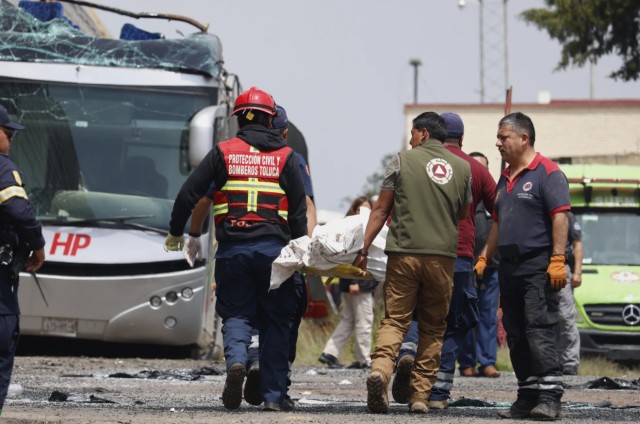
Rescue workers remove a body at the scene of a deadly accident where a freight train slammed into a double-deck bus in Atlacomulco, Mexico, Monday, Sept. 8.
A routine Monday morning commute to Mexico City turned into tragedy when a freight train collided with a double-decker bus carrying workers. The horrific train-bus collision killed at least 10 people and injured more than 50 others, leaving families desperate for answers.
Survivors Recall Moments of Fear
Minutes before the crash, 38-year-old Isabel Segundo was speaking to her daughter, Yoana, a 17-year-old domestic worker on board the bus. When news of the fatal accident spread, Isabel feared the worst.
“I thought my daughter had died,” she said, recalling unanswered calls that only reached voicemail.
Hours later, she found relief outside a hospital, learning her daughter survived. Dozens of families gathered there, anxiously waiting for updates. Medical workers shouted names through megaphones while ambulances rushed patients to different hospitals.
Families Wait Outside Hospitals
The atmosphere outside medical centers was tense. Women cried, while others set up tents for an overnight vigil. Inside, doctors worked tirelessly as injured passengers were transferred across the State of Mexico.
Nearby, eyewitnesses described the terrifying moment. “We heard the train horn. Then the crash. We never imagined it was a bus,” said Miguel Sánchez, who was starting his shift at a gas station.
Collision in Atlacomulco
The accident occurred in Atlacomulco, about 80 miles northwest of Mexico City. Videos show the bus slowly edging onto the tracks amid heavy traffic. Despite a stop sign and an old railroad crossing sign, there were no protective gates or warning lights.
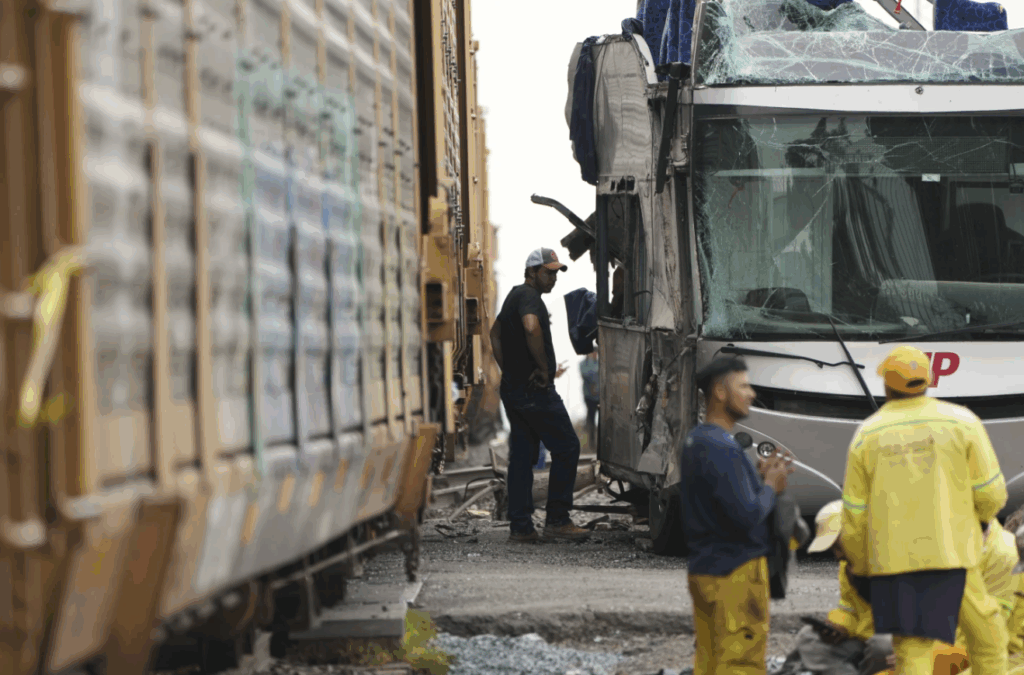
The train tore the bus in half, scattering clothing and belongings across the wreckage. Survivors on the top deck screamed for help as rescuers rushed in.
Families Demand Accountability
Rebeca Miranda waited near the crash site for updates on her injured sister and her sister’s daughter-in-law, who was killed. Both women were domestic workers.
“This shouldn’t have happened,” Miranda said. “Why risk lives to beat a train?”
For many, the tragedy highlighted longstanding safety failures. Mexico’s Rail Transportation Regulating Agency reported that grade-level crossing accidents are the most common and increasing. More than 800 accidents were recorded last year, compared to 602 in 2020.
Previous Fatal Train Accidents in Mexico
This is not an isolated case. Just last month, six people died in Guanajuato when a train struck several vehicles. In 2019, nine were killed in a similar train-bus collision in Querétaro.
The pattern raises urgent questions about crossing safety and enforcement.
Companies Respond After the Crash
The bus company, Herradura de Plata, issued a statement saying it was assisting victims’ families with medical, legal, and logistical support. “We deeply regret this accident,” the company said.
Canadian Pacific Kansas City of Mexico, the train operator, urged drivers to obey railroad signage and full stop rules at crossings.
A Family’s Uncertain Future
Among the survivors was 50-year-old laborer Alberto Maximino de Jesús. His wife, Florencia, said he called moments after the crash.
“‘We had an accident, a train ran us over,’” she recalled him saying before the call cut off.
Though stable, Alberto’s future remains uncertain. “He’s our family’s provider,” Florencia said. “Now I want to know how the bus company will take responsibility.”
Rising Concerns Over Train-Bus Collisions
The Atlacomulco train-bus collision has once again exposed the dangers of poorly managed railroad crossings in Mexico. With accidents on the rise, families and survivors are demanding stronger safety measures and accountability before another tragedy strikes.