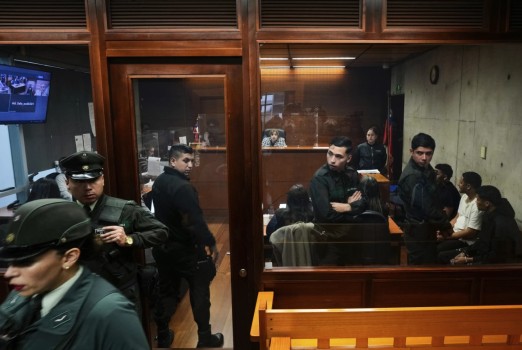
Alleged members of the Tren de Aragua gang attend a preliminary hearing facing homicide charges, in Santiago, Chile, July 9, 2025.
Chile has become the unexpected frontline in the battle against Tren de Aragua, a violent Venezuelan criminal gang once labelled a terrorist group by former U.S. President Donald Trump. As the gang expanded across Latin America, Chilean investigators in the northern city of Arica have delivered one of the most significant blows yet — uncovering the gang’s financial operations, dismantling local cells, and sending dozens of leaders to prison.
Cracking the Code of a Multinational Criminal Enterprise
When Chilean police raided properties in Arica, they didn’t just find weapons or drugs. They discovered detailed spreadsheets — records that included Uber fares, coffee purchases, and torture chamber supplies. These blue-pen entries exposed Tren de Aragua’s deeply organized accounting system, resembling that of a multinational corporation.
These documents became the cornerstone of an extensive investigation led by Chilean prosecutors. They helped secure convictions for 34 gang members in March, followed by another case earlier this month that sentenced 12 leaders to a combined 300 years in prison.
A Contrast to Trump’s Approach
While the Trump administration focused on deporting suspected gang members, Chile’s strategy emphasized deep investigation and legal prosecution. Experts argue that U.S. mass deportations overlooked a crucial opportunity to expose and dismantle the gang’s internal networks.
“Snatching guys off the streets only removes the tip of the iceberg,” said Daniel Brunner, a former FBI agent. “You need to understand the operation to truly stop it.”
Gang Violence Disrupts Chile’s Peace
Tren de Aragua infiltrated northern Chile in 2021, using the chaos of post-pandemic migration. With borders closed and desperation rising among Venezuelan migrants, the gang saw opportunity. They moved into Cerro Chuño, a slum built on a former toxic dump outside Arica.
There, the gang demanded protection payments from local shops and brutalized anyone who resisted. One local, Saida Huanca, described being so afraid she wouldn’t leave her home. Victims were tortured in hidden rooms, rivals were dismembered, and some were buried alive under cement.
Between 2019 and 2022, homicides in Arica surged by 215%.
Following the Money Trail
Without witness testimonies — gang members rarely talk — investigators turned to Tren de Aragua’s own records. Prosecutor Bruno Hernández and his team discovered a rigid structure. Each local cell operated independently but adhered to central leadership protocols.
Human trafficking and sex work were the gang’s main revenue sources. Documents showed women were charged for rent and food, creating debt bondage. Hitmen earned up to $1,000 per job, and Christmas bonuses were paid. Some emojis in chat apps helped code operations: bones for debt, pineapples for safehouses, rainclouds for raids.
A Legal Victory Sparks National Action
After the convictions, violence in Arica dropped sharply. The city’s homicide rate fell from 17 per 100,000 in 2022 to under 10 in 2023.
Chile’s justice system took notice. Investigations expanded across the country. Prosecutors shared intelligence with the FBI, and Chile’s organized crime office praised the Arica team’s success.
“Chile did something unprecedented,” said Ignacio Castillo, a top official. “Now we’re seeing the impact nationwide.”
Deportation vs. Prosecution: A Debate in Policy
While Chile focused on legal prosecution, other nations, including the U.S., have struggled to hold Tren de Aragua accountable. Deportations often target individuals for minor infractions, like gang-related tattoos, rather than building substantial criminal cases.
Security experts warn that current U.S. policies may even help organized crime by removing suspects without uncovering networks. “The kind of investigations Chile led just aren’t happening in the U.S.,” Brunner said.
The Fight Isn’t Over
Even with gang leaders behind bars, threats continue. Businesses in Cerro Chuño report ongoing extortion — now via prison phones. Prosecutors know the gang is adapting and regrouping.
“Organized crime evolves fast,” Hernández said. “We have to stay one step ahead.”
Politics and Public Sentiment Shift in Chile
Crime has reshaped Chile’s political climate. Public concern over safety has surged ahead of the November presidential elections. The current frontrunner, far-right candidate José Antonio Kast, promises harsh immigration crackdowns and a border wall.
Many Chileans support his stance. “You can’t walk outside at night anymore,” said 70-year-old Maria Peña. “Things changed when new kinds of people came.”
Chile, once Latin America’s safest nation, is now grappling with organized crime’s chilling impact. But its measured, law-driven fight against Tren de Aragua offers a rare example of progress in a region increasingly overwhelmed by violence.