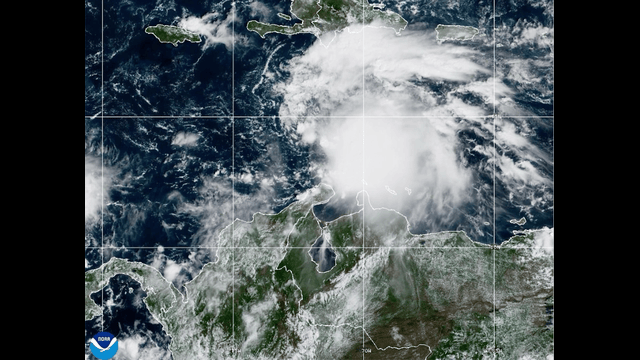
This NOAA satellite image was taken at 11:40 a.m. EST on Tuesday, Oct. 21, 2025, shows Tropical Storm Melissa in the Central Caribbean Sea.
Tropical Storm Melissa is sweeping slowly through the Caribbean, unleashing heavy rainfall and raising fears of flooding and landslides across the region. Officials in Jamaica, Haiti, and the Dominican Republic have issued urgent warnings and urged residents in vulnerable areas to take shelter or move to higher ground.
Islands Brace for Impact
As Melissa crawled westward on Thursday, Jamaica and southern Hispaniola faced the greatest risk. Authorities across the region were preparing for potential disaster. In the Dominican Republic, schools, businesses, and government offices were ordered closed across nine provinces under storm alert. More than half a million people were affected as dozens of water supply systems went offline.
Meanwhile, emergency shelters began filling up as families sought safety from the approaching storm. In Jamaica, officials announced that 881 shelters were ready to accommodate evacuees. Courts were shut, and schools shifted to online learning as the nation prepared for the onslaught of rain and wind.
Torrential Rainfall Expected
Evan Thompson, Director of Jamaica’s Meteorological Service, warned that the island’s eastern regions could receive up to 12 inches (30 centimeters) of rainfall. “That is significant rainfall,” Thompson said, emphasizing the risk of flash floods and landslides in steep areas.
Forecasts predict similar rainfall totals for southern Haiti and the southern Dominican Republic through Saturday, with localized areas potentially receiving even more. Heavy showers are also expected in western Jamaica, southern Hispaniola, Aruba, and Puerto Rico.
Haiti Faces Additional Challenges
Haiti, already struggling with deep political instability, gang violence, and economic hardship, remains especially vulnerable. Years of weakened infrastructure have left the country ill-equipped to handle another major storm. Emergency preparation efforts were limited, heightening concerns about the potential human toll if Melissa intensifies further.
Melissa’s Path and Strengthening Threat
According to the U.S. National Hurricane Center (NHC) in Miami, Melissa was moving west at just 2 mph (4 kph) late Wednesday, packing sustained winds of 50 mph (85 kph). The storm was centered about 335 miles (535 kilometers) south-southwest of Port-au-Prince, Haiti, and 295 miles (475 kilometers) south-southeast of Kingston, Jamaica.
Meteorologists expect Melissa to move closer to Jamaica and southwestern Haiti later this week. Forecast models indicate gradual strengthening, with the potential for Melissa to reach hurricane status by Friday. By the weekend, it could escalate into a major hurricane, carrying life-threatening winds and storm surges.
“Unfortunately, it is becoming increasingly likely that Melissa will become a large and dangerous hurricane,” the NHC warned in its latest advisory.
A Busy Hurricane Season
Melissa marks the 13th named storm of the 2025 Atlantic hurricane season—and notably, the first to form in the Caribbean this year. The National Oceanic and Atmospheric Administration (NOAA) had earlier predicted an above-normal season, with 13 to 18 named storms expected. Out of these, five to nine are forecast to develop into hurricanes, and as many as five could reach major hurricane status, with winds exceeding 111 mph.
Season of Vigilance
The Atlantic hurricane season runs from June 1 to November 30, and Melissa’s arrival underscores the need for continued vigilance. With much of the Caribbean already facing economic hardship and fragile infrastructure, even moderate storms can cause widespread disruption.
As residents brace for impact, officials continue to urge calm, preparation, and close attention to local weather updates. For many across the islands, the coming days will test both resilience and readiness in the face of another powerful tropical storm.