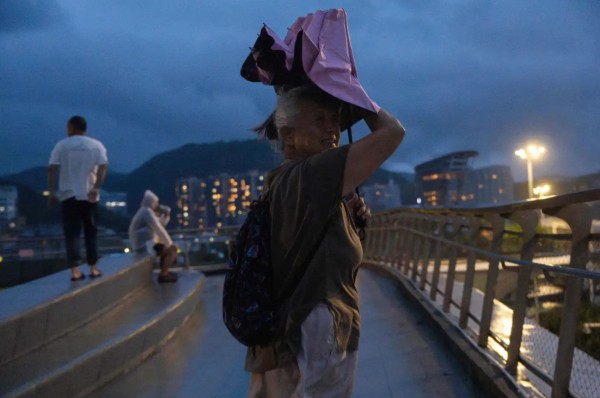
An elderly woman shelters from the rain in the aftermath of Super Ragasa in Shenzhen in southern China's Guangdong province on Wednesday, Sept 24, 2025.
Tropical Storm Ragasa continued moving west on Thursday, skirting along China’s southern coast toward Vietnam. The storm, once the world’s strongest cyclone this year, left behind severe flooding, power outages, and fatalities across several Asian nations.
Streets Submerged in Guangdong
In Guangdong province, Ragasa’s impact was widespread. Streets in Yangjiang city were submerged, with tree branches floating on floodwaters. Excavators worked tirelessly to remove thousands of fallen trees that had blocked main roads. State broadcaster CCTV reported that more than 50,000 trees were destroyed and road signs torn down by powerful winds.
Zhuhai city saw similar devastation, with streets resembling rivers. Rescue teams deployed inflatable boats to save stranded residents from flooded neighborhoods. Some older districts reported first-floor homes completely inundated, Southern Metropolis Daily confirmed.
By Wednesday night, more than 56,000 households in Guangdong were without electricity. The Guangxi region to the west also suffered, with schools and businesses shut and tourism activities halted.
Millions Relocated for Safety
Authorities had moved over 2 million residents in Guangdong ahead of Tropical Storm Ragasa. At its peak on Monday, Ragasa reached super-typhoon strength with winds of 265 kph (165 mph), making it the world’s most powerful storm of the year.
By Thursday, the system had weakened drastically, with sustained winds dropping to 65 kph (40 mph). Although much weaker, Ragasa remained a rainfall threat for Vietnam and parts of Southeast Asia.
Vietnam Braces for Heavy Rain
Vietnam Prime Minister Phạm Minh Chính directed ministries and local authorities to prepare for the storm’s arrival. Officials were ordered to secure dams, hospitals, fishing boats, and coastal infrastructure. Emergency evacuation and rescue plans were placed on high alert.
Some flights were canceled or rescheduled in northern Vietnam as workers trimmed trees to minimize risks from strong winds.
Normalcy Slowly Returning in Hong Kong
Earlier in the week, Hong Kong, Guangzhou, and Shenzhen had suspended activities under Ragasa’s threat. By Thursday, normalcy was returning. Flights resumed after about 1,000 disruptions had stranded more than 140,000 passengers. Businesses reopened, though the cleanup continued.
Over 1,200 trees were toppled across Hong Kong, leaving debris scattered on roads. Hospitals reported around 100 people injured during the storm.
Taiwan Revises Death Toll
Taiwan revised its storm-related death toll from 17 to 14 after repeated records were clarified. Most victims were from Hualien County, where relentless rain caused a barrier lake to overflow. Floodwaters surged into Guangfu township, washing away vehicles, homes, and a bridge.
Roads turned into rivers of mud and debris. Some residents remained missing, while dozens more sustained injuries across the island.
Deadly Impact in the Philippines
In the Philippines, Tropical Storm Ragasa claimed at least 11 lives. Seven fishermen drowned in Cagayan province after their boat overturned on Monday. Two others were still missing by Thursday.
The storm battered northern regions with rough seas and strong winds, forcing many coastal families to evacuate.
Another Storm Looms Over the Philippines
Even as Ragasa weakened, another tropical storm approached from the Pacific. Known as Opong locally and Bualoi internationally, the system was forecast to make landfall in east-central Philippines on Friday.
Forecasters warned that Opong could strengthen into a typhoon, with sustained winds of 110 kph (68 mph) and higher gusts.
Tropical Storm Ragasa Leaves a Lasting Mark
Although Ragasa weakened before reaching Vietnam, its destruction in China, Taiwan, and the Philippines highlights the growing vulnerability of coastal regions. From uprooted trees in Guangdong to deadly floods in Taiwan, the storm left millions affected and recovery efforts stretched thin.