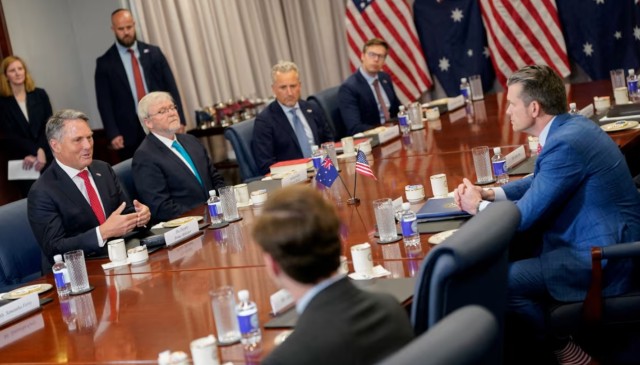
US Defense Secretary Pete Hegseth meets with Australian Defense Minister and Deputy Prime Minister Richard Marles at the Pentagon in Washington, DC, on February 7.
The Trump administration has initiated a comprehensive review of the AUKUS submarine pact, a landmark security agreement signed during Joe Biden’s presidency between the United States, the United Kingdom, and Australia. The pact was designed to boost collective security in the Indo-Pacific by supplying Australia with nuclear-powered submarines.
However, under Trump’s "America First" policy framework, the agreement is being reassessed to ensure it aligns with U.S. strategic priorities.
Australia Stands Firm Despite AUKUS Review
Australia has reiterated its commitment to the AUKUS pact, even amid Washington’s review. The Australian government views nuclear-powered submarines as vital to national defense, particularly in light of China’s increasing military assertiveness in the region.
Canberra has stated that it will continue working closely with the U.S. throughout the review process. Australian officials emphasized that AUKUS supports both nations’ defense industries and will create thousands of jobs while strengthening long-term security ties.
Strategic Uncertainty for the UK
Britain, another key AUKUS partner, could also face challenges if the deal is modified. The UK is banking on the agreement to expand its own submarine fleet, including developing and building next-generation attack submarines with U.S. and Australian cooperation.
British officials labeled AUKUS as one of the most crucial defense partnerships in recent decades. They emphasized its role in creating jobs and boosting economic growth. “It’s natural for a new U.S. administration to review major international deals,” a UK spokesperson noted, while stressing continued collaboration.
What the AUKUS Agreement Envisions
AUKUS was launched in 2021 to counter China’s rising influence in the Indo-Pacific. The plan outlines Australia’s acquisition of up to five Virginia-class nuclear-powered submarines starting in 2032. Following that, the UK and Australia, with U.S. support, will co-develop a new class of submarines.
By 2027, the U.S. and UK are expected to rotate their own submarines through a base in Western Australia, establishing a permanent regional presence.
Growing Concerns Over U.S. Submarine Supply
Some Trump-era defense officials have expressed skepticism. Elbridge Colby, a senior Pentagon adviser, warned that nuclear submarines are in short supply and essential to U.S. military plans in Asia. He questioned the logic of transferring such critical assets abroad when domestic needs are not being fully met.
“The First Island Chain, from Japan to the Philippines, is key in deterring China,” Colby noted. “These submarines are irreplaceable assets.”
Currently, only six nations possess nuclear-powered submarines: the U.S., UK, China, Russia, France, and India. The addition of Australia to that list represents a major strategic shift in regional military dynamics.
Political Debate in the U.S. Over AUKUS Pact
While some Republicans question the wisdom of transferring valuable submarines overseas, others, like Democratic Senator Tim Kaine, argue the opposite. Kaine insists that strengthening AUKUS is critical to maintaining a free and open Indo-Pacific.
“Undermining the pact would only benefit China,” Kaine said. He emphasized support for the U.S. submarine industrial base as part of long-term strategy.
Trump officials said the review is not intended to cancel the pact but to ensure it benefits the U.S. economically and strategically. “Every foreign deal must be examined in light of American interests,” one official told Reuters.
Australia’s Costliest Defense Investment
For Australia, AUKUS is the largest defense initiative in its history. Canberra has pledged AU$368 billion (US$240 billion) over the next 30 years, which includes a substantial investment into the U.S. submarine industry.
In parallel, the UK announced a multibillion-pound investment to expand its submarine production capacity, including facilities run by BAE Systems and Rolls-Royce Submarines.
Some Fear Australia May End Up Empty-Handed
Former Australian Prime Minister Malcolm Turnbull, who brokered an earlier submarine deal with France before AUKUS replaced it, expressed doubts about the program’s future. He suggested Australia might ultimately receive no submarines but serve only as a strategic base for U.S. naval operations.
John Lee of the Hudson Institute added that the review may stem from the U.S. Navy’s failure to meet its own submarine production goals. Supplying submarines to allies could strain already stretched resources.
However, former Biden official Kathryn Paik argued the opposite. She believes providing submarines to Australia strengthens collective deterrence, rather than weakening U.S. readiness.
“This review risks shaking the confidence of our closest allies,” Paik warned.
“It raises doubts about America’s reliability as a long-term security partner.”