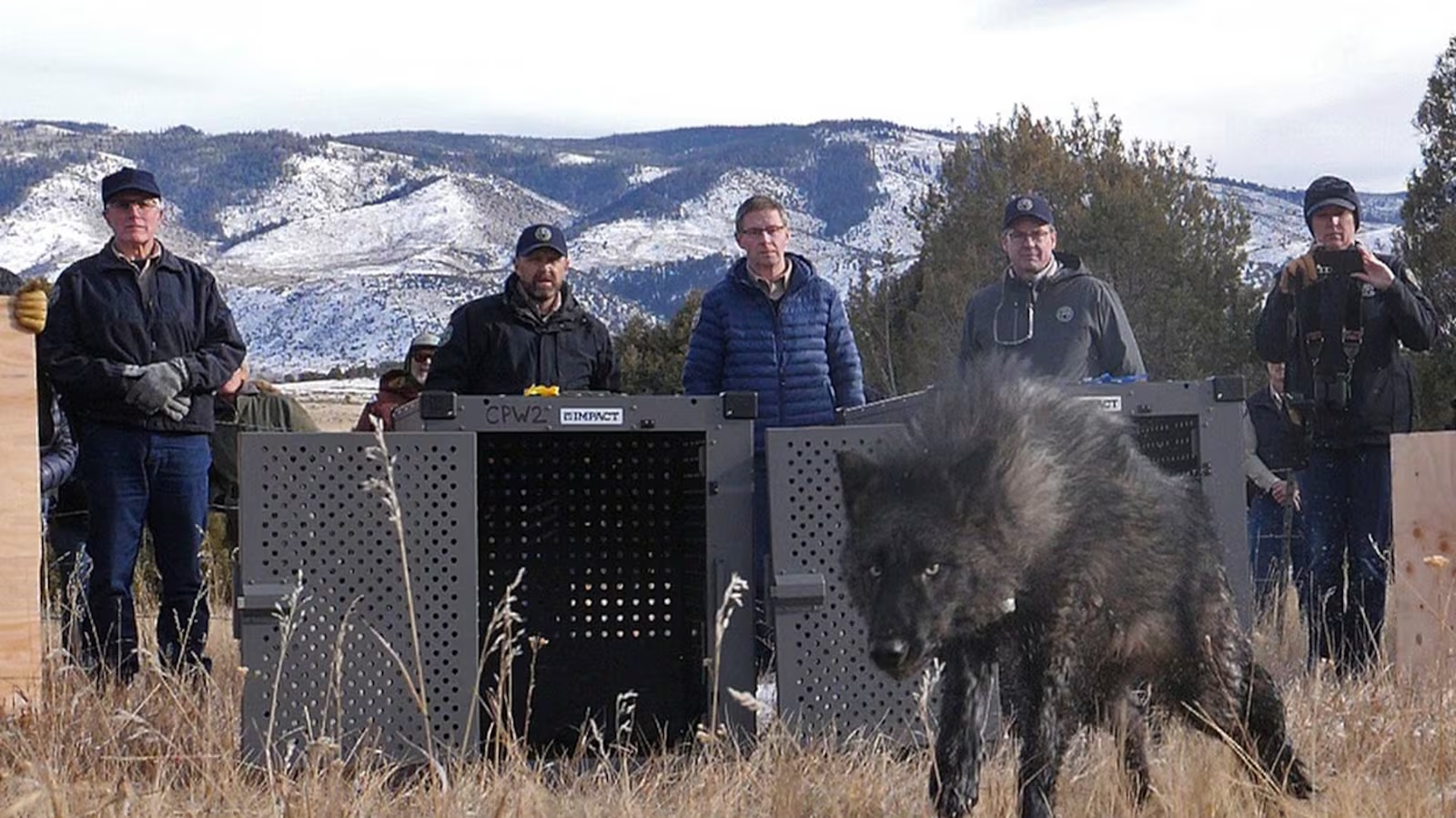
In this photo from Colorado Parks and Wildlife, officials are seen releasing five grey wolves onto public land in Grand County, Colorado, on December 18, 2023. AP
The Trump administration has told Colorado to stop bringing in grey wolves from Canada for its reintroduction program. The decision could delay the state’s plans to release more wolves this winter.
Colorado began releasing wolves west of the Continental Divide in 2023, following a narrow public vote in 2020 that approved their return. Around 30 wolves now live across the state’s mountain regions. Wildlife officials hope to eventually grow the population to more than 200.
The effort has faced strong opposition in rural communities, where some farmers say wolves have killed livestock. Now, with the shift in Washington, the project faces a new hurdle.
Trump Administration Changes Direction
In a recent letter, U.S. Fish and Wildlife Service Director Brian Nesvik told Colorado Parks and Wildlife Director Jeff Davis that wolves for the program must only come from U.S. northern Rocky Mountain states.
Colorado must “immediately cease and desist any and all efforts related to the capture, transport and/or release of gray wolves not obtained” from those states, Nesvik wrote.
That includes wolves from Canada, which have been an important source for Colorado’s recent releases.
Canadian Partnership in Jeopardy
Colorado signed an agreement with British Columbia earlier this year to relocate 10 to 15 wolves. The goal was to continue building the population in the state.
Colorado Parks and Wildlife spokesperson Luke Perkins said the state received the federal letter on October 10, after the deal with British Columbia had already been made.
Perkins said officials are now reviewing their options to “support this year’s gray wolf releases” after receiving the new federal directive.
So far, Colorado’s wolves have come from both Oregon and British Columbia. However, most northern Rocky Mountain states—Idaho, Montana, and Wyoming—have refused to send wolves to Colorado. These states have their own wolf management programs and long-standing tensions over wolf populations.
Legal and Conservation Debate
The federal order raised questions about whether the new restriction is legal. When the U.S. Fish and Wildlife Service approved Colorado’s “experimental” wolf population in 2023, it called the northern Rockies the “preferred” source—not a mandatory one.
Defenders of Wildlife attorney Lisa Saltzburg criticized the decision, saying the agency was “twisting language” to block the use of Canadian wolves.
“People in Colorado should be proud of their state’s leadership in conservation and co-existence,” Saltzburg said. “The wolf reintroduction program illustrates those values.”
Governor Jared Polis’s office confirmed that the state is discussing the issue with the U.S. Interior Department. Officials are exploring “all options” to keep the reintroduction effort on track.
As of Friday, U.S. Fish and Wildlife spokesperson Garrett Peterson did not respond to requests for comment.