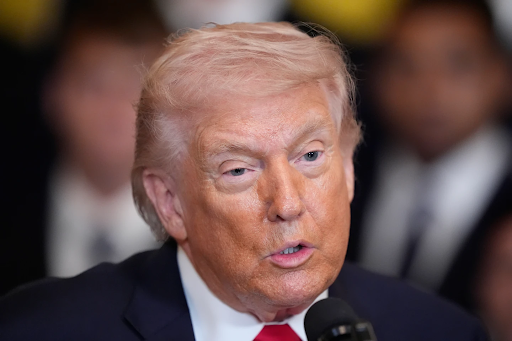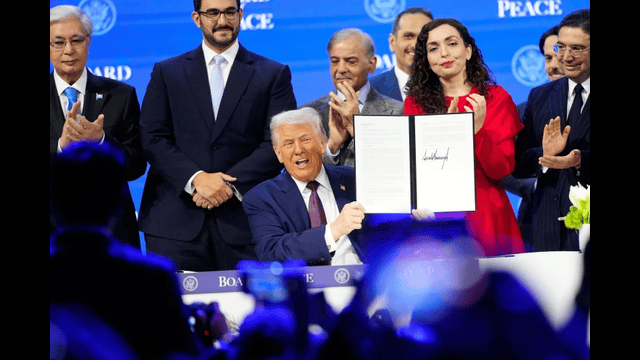
President Donald Trump holds the charter during a signing ceremony on his Board of Peace initiative at the Annual Meeting of the World Economic Forum in Davos, Switzerland, Thursday, Jan. 22, 2026.
President Donald Trump on Thursday unveiled his ambitious Board of Peace, pitching it as a powerful new body to safeguard a fragile ceasefire in Israel’s war with Hamas. Speaking at the World Economic Forum in Davos, Trump claimed overwhelming interest, saying “everyone wants to be a part,” even as several close U.S. allies chose not to join.
The initiative arrives at a crowded moment. Trump’s Gaza vision has struggled for attention after his recent Greenland remarks and swift reversal dominated headlines.
A Vision Bigger Than First Planned
The Board of Peace was initially conceived as a compact council of world leaders. Its sole focus was Gaza’s ceasefire. Trump was to serve as chairman.
That idea has since expanded dramatically. The board is now framed as a global peace platform. Trump has even suggested it could rival parts of the United Nations.
That ambition has unsettled many governments. Several allies remain cautious about its scope, authority, and long-term intent.
Allies Step Back From Participation
Norway and Sweden confirmed they will not participate in the Board of Peace. France declined as well. French officials cited concerns about undermining the United Nations.
Canada stopped short of committing. Prime Minister Mark Carney spoke bluntly in Davos about a “rupture” in the rules-based order.
Trump responded sharply on social media. He announced the board had withdrawn its invitation to Canada. He called the panel “the most prestigious Board of Leaders ever assembled.”
How Many Countries Are Really On Board?
Trump insists support is growing. He told reporters the Board of Peace could attract more than 50 countries.
At the Davos launch, however, officials from only 19 nations appeared. They included Azerbaijan, Paraguay, and Hungary.
While returning to Washington, Trump said nearly 30 leaders had already responded. He added that some await parliamentary approval. He specifically mentioned Italy’s Giorgia Meloni and Poland’s Karol Nawrocki.
Charter Questions Raise Eyebrows
The board’s charter has not been released publicly. That has fueled uncertainty around governance and accountability.
When asked if he could remain chairman beyond his presidency, Trump said the option exists. “In theory, for life,” he remarked, while adding he was undecided.
Trump has floated replacing some U.N. functions. Later, he softened his tone. He said the Board of Peace would work alongside the U.N., not against it.
Gaza Developments Add More Uncertainty
At the event, Gaza’s future technocratic leader, Ali Shaath, announced plans to reopen the Rafah border crossing next week. He said movement would resume in both directions.
Israel has not confirmed that claim. Officials said the issue would be reviewed next week. The crossing remains under Israeli military control.
The Board of Peace traces back to Trump’s 20-point Gaza ceasefire plan. That proposal received endorsement from the U.N. Security Council.
Diplomatic Unease Behind the Scenes
An Arab diplomat in Europe said regional governments coordinated their response carefully. Acceptance of the board, the diplomat said, is preliminary.
The diplomat added that parts of the proposed charter contradict the U.N. mission. Other major powers are unlikely to support the board in its current form.
Questions also surfaced over invitations to Russia and other authoritarian states. Britain’s foreign secretary voiced concern about Vladimir Putin’s inclusion, citing the ongoing war in Ukraine.
Russia, Ukraine, and Stalled Peace
Putin said Russia is still consulting partners before joining the Board of Peace. He hosted Palestinian President Mahmoud Abbas in Moscow the same day.
The Kremlin said Putin may propose a $1 billion humanitarian contribution. The funds would come from assets previously blocked by the U.S. Trump said he supported the idea.
Trump also met privately with Ukrainian President Volodymyr Zelenskyy in Davos. He described the meeting as good, but inconclusive.
Peace in Ukraine remains elusive. Trump acknowledged repeated sticking points. He said both Putin and Zelenskyy now want a deal.
Iran Adds Another Layer of Risk
Trump’s peace push comes after sharp tensions with Iran. He recently threatened military action over Tehran’s violent protest crackdown.
For now, Trump says no strikes are planned. He cited assurances that mass executions would not proceed.
Still, the U.S. is moving naval assets toward Iran. Trump also reiterated plans for 25% tariffs on countries trading with Tehran.
Details remain unclear. Like the Board of Peace itself, much about Trump’s latest initiative is still unfolding.