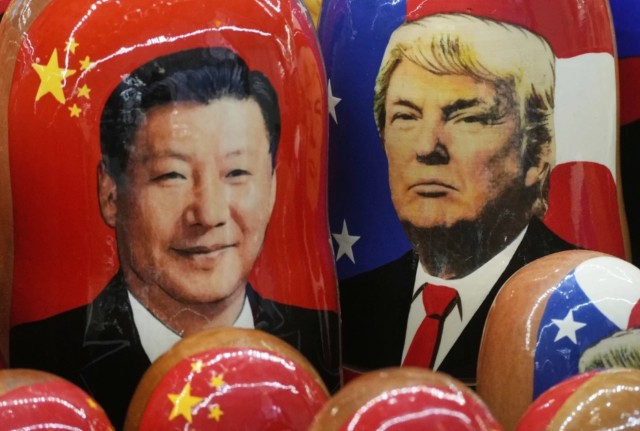
Traditional Russian wooden dolls called Matryoshka depicting China’s President Xi Jinping and President Donald Trump at a souvenir shop in St. Petersburg, Russia, Nov. 21, 2024.
President Donald Trump’s eagerness to meet Chinese President Xi Jinping has sparked new debate in Washington. With no summit confirmed yet, his strong desire for a face-to-face discussion is being viewed as a double-edged sword in the already tense and complex U.S.-China relationship.
Deal or Danger?
Trump appears determined to secure a new trade agreement with China, even if it means offering concessions. Experts fear he might soften export controls or ease investment restrictions just to keep summit talks alive. Craig Singleton, senior director at the Foundation for Defense of Democracies, warns that such a move risks not only “giving away too much” but also “letting Beijing set the tempo.”
The summit, expected to take place in the fall if it happens at all, is seen by many as essential for sealing a deal. But with Trump keen and China seemingly reluctant, the power dynamics appear skewed.
An Unpredictable Approach
U.S.-China relations have always been volatile, from the 1989 Tiananmen crackdown to recent COVID-era tensions. But Trump’s second-term unpredictability adds a fresh twist. His unconventional approach to diplomacy is raising both hopes and alarms.
Unlike previous presidents, Trump shows little regard for traditional boundaries. Gabriel Wildau of Teneo says, “With Trump, everything is up for negotiation.” That attitude worries China hawks within his own party, who fear he might make hasty or excessive compromises just to strike a “big, beautiful deal.”
Partisan Reactions Emerge
While Republican lawmakers remain mostly silent, Democrats are voicing serious concern. Rep. Gregory Meeks called Trump’s eagerness to appease Xi “a giveaway” that could economically harm American families.
Yet the Trump administration insists it remains firm on national and economic security. Spokesperson Kush Desai emphasized that talks with China continue without undermining American interests. Export controls and tariffs are reportedly still intact, despite minor rollbacks.
Taiwan in the Crosshairs?
Taiwan’s place in U.S.-China trade talks is causing anxiety in Taipei. Last month, the White House allegedly denied Taiwanese President Lai Ching-te permission to pass through the U.S.—a break from long-standing policy. Experts see this as a troubling sign.
Jason Hsu, a senior fellow at the Hudson Institute, fears Taiwan could become a bargaining chip. The island is pushing to reframe itself not as a political liability but as a valuable economic ally to the U.S. Hsu urged Taiwan to boost defense ties, energy imports, and U.S. investments to strengthen its strategic value.
Still, analysts say Trump can’t completely cut ties with Taiwan. The Taiwan Relations Act legally binds the U.S. to maintain unofficial relations and provide military aid to deter Chinese aggression.
“He can adjust the relationship,” said Sun Yun of the Stimson Center, “but he can’t erase it.”
Export Controls: A Slippery Slope?
One of the most hotly debated issues is whether Trump might roll back high-tech export controls to appease China. In April, the U.S. restricted sales of Nvidia’s H20 chips to China over national security concerns. Just three months later, the ban was lifted.
Lawmakers from both parties were furious. Rep. John Moolenaar warned against letting U.S. chips help the Chinese military and suppress free speech. But Treasury Secretary Scott Bessent defended the decision, insisting national security reviews remain thorough and interagency-led.
Despite those assurances, critics worry the H20 case signals a shift. Wildau cautioned that what was once “non-negotiable” under Biden might become flexible under Trump.
Balancing Act Ahead
Trump’s pursuit of a deal with Xi Jinping is reigniting questions about how far the U.S. should go to maintain economic stability with China. While avoiding full-blown trade conflict is crucial, critics say it shouldn't come at the cost of American security or democratic values—especially concerning Taiwan.
As fall approaches and speculation around a potential summit grows, all eyes remain on how Trump navigates this tricky terrain. The stakes—for trade, tech, and global diplomacy—couldn’t be higher.