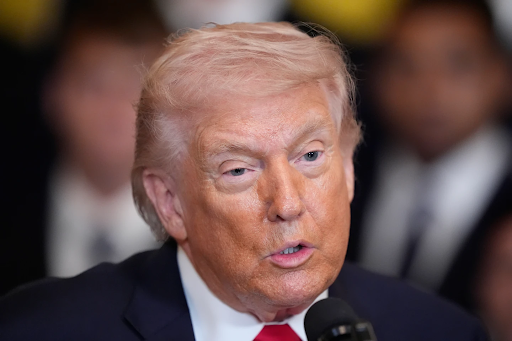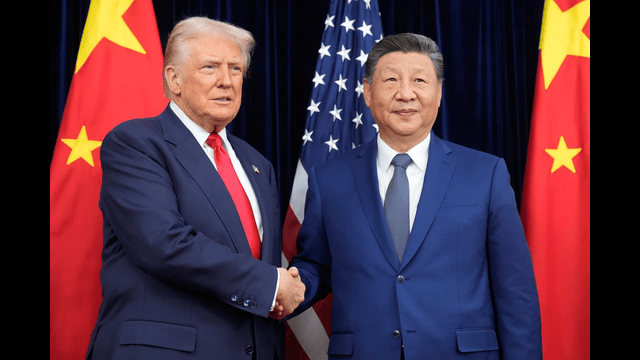
President Donald Trump, left, and Chinese President Xi Jinping shake hands before their meeting at Gimhae International Airport in Busan, South Korea, Thursday, Oct. 30, 2025.
In a surprising turn for global trade, President Donald Trump announced a major tariff cut on China after what he described as a “tremendously successful” meeting with Chinese President Xi Jinping in South Korea.
Speaking aboard Air Force One, Trump said the U.S. would lower tariffs on Chinese exports from 20% to 10%. The total combined tariff rate will now stand at 47%, down from 57%.
“I’d rate this meeting a 12 out of 10,” Trump told reporters. “It couldn’t have gone better.”
China Agrees to Major U.S. Soybean Purchases
Treasury Secretary Scott Bessent confirmed that China agreed to purchase 25 million metric tons of American soybeans every year for the next three years. The first shipment of 12 million metric tons will be made before January.
U.S. soybean exports had nearly halted amid trade tensions, causing heavy losses for American farmers.
“Our soybean farmers were used as political pawns,” Bessent said on Fox Business. “That’s over now. They can expect prosperity ahead.”
The two nations also discussed future cooperation in technology, including potential exports of advanced computer chips to China. Trump mentioned that Nvidia would soon begin talks with Chinese officials.
Path Toward a New Trade Deal
Trump hinted that a new trade deal with China could be signed “very soon.”
He also announced that he would visit China in April, while Xi is expected to make a U.S. visit later in the year.
Xi expressed similar optimism, saying both nations would “finalize agreements that provide peace of mind to the world.” He emphasized focusing on cooperation rather than “a vicious cycle of retaliation.”
However, despite the friendly tone, tensions continue to linger between the world’s two largest economies. Both nations are vying for leadership in global manufacturing, artificial intelligence, and influence over conflicts like the war in Ukraine.
Meeting in Busan Sparks Hope for Stability
The high-stakes meeting took place in Busan, a coastal city in South Korea, just before the Asia-Pacific Economic Cooperation (APEC) summit.
In the days leading up to the summit, both sides showed signs of flexibility. Trump backed away from his earlier threat to impose a 100% import tax on Chinese goods, while Beijing indicated it would ease export restrictions on rare earth minerals.
Officials from both countries met earlier in Kuala Lumpur to lay the groundwork. Chinese trade negotiator Li Chenggang described the discussions as reaching a “preliminary consensus.” Bessent called it a “very successful framework.”
The atmosphere of the meeting was modest. Unlike grand international summits, Trump and Xi met in a small gray building near Busan’s international airport — a symbol of quiet diplomacy rather than showmanship.
Markets React Positively as Trade Tensions Ease
Following Trump’s announcement, U.S. markets showed signs of relief. Investors welcomed the move, seeing it as a step toward easing economic uncertainty.
For months, businesses caught between the two powers had been anxiously watching for progress. The tariff cut and China’s renewed interest in American imports have brought some much-needed confidence.
Pressure Points Still Unresolved
Despite optimism, analysts caution that this may be only a temporary pause in the ongoing economic rivalry.
Craig Singleton, Senior Director at the Foundation for Defense of Democracies, described the deal as “short-term stabilization dressed up as strategic progress.”
The U.S. has used tariffs to pressure China over issues like fentanyl production, while China has leveraged its dominance in rare earth exports — critical for electric vehicles, fighter jets, and electronics.
Earlier this month, Trump had threatened a 100% import tax after China tightened rare earth controls. Thursday’s tariff reduction reverses that escalation, at least for now.
Xi, meanwhile, plans to stay in South Korea to meet with other regional leaders during the APEC summit, aiming to position China as a “reliable partner” amid U.S. tariff turbulence.
A Fragile Truce in a High-Stakes Rivalry
Trump’s decision to cut tariffs on China signals a temporary easing of trade tensions but doesn’t eliminate deeper competition.
Both nations appear to recognize the global risks of prolonged confrontation — and for now, cooperation seems the safer bet.
As the two leaders look to finalize a deal in the coming months, the world watches closely — hoping this fragile truce marks the start of lasting economic stability.