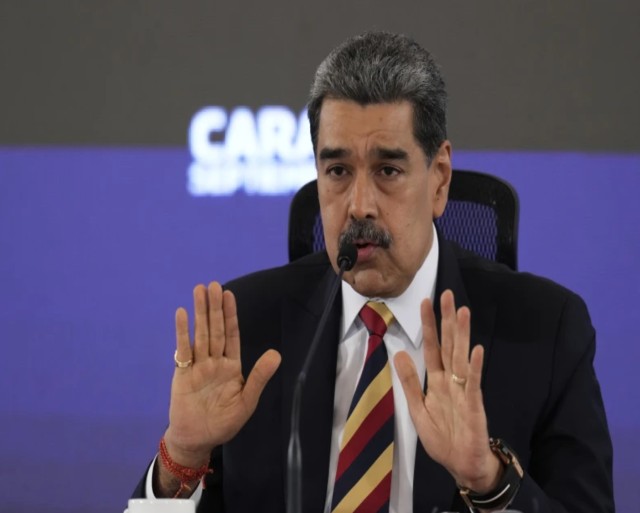
President Nicolas Maduro gives a press conference in Caracas, Venezuela, Monday, Sept. 1, 2025.
President Donald Trump defended the recent U.S. military strike on a Venezuelan gang, calling it a necessary step to warn Latin American cartels. The strike, carried out in international waters, killed 11 suspected members. Trump said the operation would make drug traffickers reconsider moving drugs into the United States.
“There was massive amounts of drugs coming into our country,” Trump said during a press briefing with Polish President Karol Nawrocki. “Obviously, they won’t be doing it again. And others will think twice.”
A Departure from Traditional Drug Interdiction
Tuesday’s strike marked a major shift from traditional U.S. anti-narcotics operations. The Trump administration has been building up naval presence near Venezuela, signaling a more aggressive approach.
Secretary of State Marco Rubio supported the move. He said previous U.S. interdiction strategies had failed to curb the drug trade. “What will stop them is when you blow them up,” Rubio remarked during a visit to Mexico.
Pentagon and Administration Stand Firm
Defense Secretary Pete Hegseth claimed the gang involved was the Venezuelan group Tren de Aragua. He described Venezuelan President Nicolás Maduro as running the country like a “narco-state.”
Hegseth added that the U.S. “knew exactly who was in that boat and what they were doing.” However, no evidence has yet been provided linking the vessel to Tren de Aragua. Trump still insisted the gang operates under Maduro’s control, despite U.S. intelligence assessments disputing that claim.
Is Tren de Aragua Really a Drug Cartel?
While the U.S. government designated Tren de Aragua as a foreign terrorist organization, researchers question its direct role in international drug smuggling.
Jeremy McDermott, co-founder of InSight Crime, said there is “no direct participation of TdA in the transnational drug trade.” He added that while TdA occasionally works as a subcontractor for larger cartels, its primary activities remain domestic.
Still, McDermott warned that with expanding cells across Latin America, the gang could easily shift deeper into trafficking. He noted U.S. officials often use the term TdA broadly to describe Venezuelan criminals abroad.
Legal and Political Concerns
The strike has sparked debate over its legality. Mary Ellen O’Connell, a law professor at Notre Dame, said intentional killings outside armed conflict are unlawful unless lives are immediately at risk. “No hostilities were occurring in the Caribbean,” she emphasized.
Questions also linger about Washington’s broader goals. When asked about regime change in Venezuela, Hegseth said, “That’s a presidential-level decision.”
Regional Fallout
Venezuelan President Maduro has responded by deploying troops along the coast and urging citizens to join militias. Meanwhile, the U.S. continues expanding its maritime force in the Caribbean.
Analyst Ryan Berg from the Center for Strategic and International Studies called the strike a “paradigm shift.” He argued it signals a new U.S. strategy: using direct military force against gangs and cartels.
However, Mexico’s Foreign Minister Juan Ramón de la Fuente urged Washington to respect sovereignty. He warned against unilateral U.S. actions in Latin America.
A Complicated U.S. Legacy
The strike has revived concerns over America’s history of interventions in Latin America. Past military actions during the Cold War destabilized governments in Guatemala, Chile, and Central America, leaving long-lasting turmoil.
In recent decades, Washington leaned toward foreign aid and cooperation instead of direct military strikes. But Trump’s latest move indicates a return to hard power in the region.
Whether this aggressive strategy will deter cartels—or provoke backlash—remains an open question.