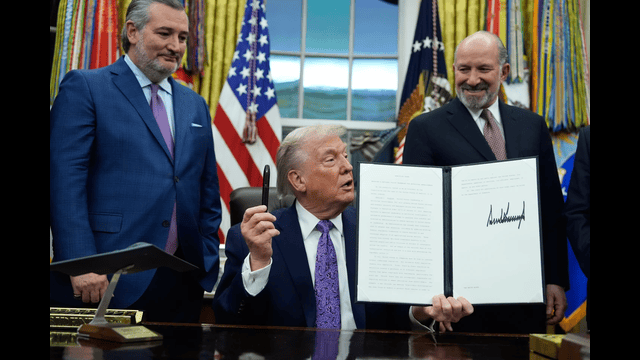
Flanked by Sen. Ted Cruz R-Texas, left, and Secretary of Commerce Howard Lutnick, President Donald Trump displays his signed AI initiative in the Oval Office of the White House, Thursday, Dec. 11, 2025, in Washington
President Donald Trump signed a sweeping executive order on Thursday aimed at blocking state-level AI regulations, arguing that fragmented rules could cripple America’s competitiveness against China in the global AI race. The move ignited immediate debate among lawmakers and civil liberties groups who have long demanded stronger oversight of artificial intelligence.
Trump Pushes for a Unified AI Strategy
Speaking from the Oval Office, Trump said the U.S. must treat AI as a national priority. He warned that America could fall behind China if companies are forced to comply with a “patchwork” of state laws.
“There’s only going to be one winner,” Trump said. He argued that China’s tightly centralized approval process gives its companies a major advantage.
Trump noted that U.S. companies face a different reality.
“If they had to get 50 different approvals from 50 different states, you can forget it,” he said. “It’s impossible to do.”
The executive order on AI regulations aims to reduce regulatory barriers and maintain a unified national framework.
What the Executive Order Does
The order lays out several major federal actions:
- Creates a new task force under the Attorney General to challenge state AI laws
- Directs the Commerce Department to identify state regulations considered restrictive or “problematic”
- Threatens limits on federal funding, including broadband deployment grants, for states that enforce their own AI rules
The administration argues that these steps are necessary to prevent states from interfering with federal innovation goals.
David Sacks, a venture capitalist helping steer Trump’s AI and cryptocurrency policies, said the administration will only push back against “the most onerous examples” of state regulation. He added that the White House will not challenge state-level kid safety measures, acknowledging growing concerns about children’s exposure to advanced AI tools.
States Already Moving Ahead on AI Rules
Despite the federal pressure, several states have already enacted their own AI regulation laws.
According to the International Association of Privacy Professionals, Colorado, California, Utah, and Texas have passed legislation that requires more transparency from AI developers and restricts certain data practices.
These laws are designed to address how AI influences everyday life, including decisions about:
- Job interviews
- Rental applications
- Home loans
- Access to medical care
Research shows that AI systems can amplify biases, sometimes favoring one gender or race over another. This has intensified calls for stricter oversight to prevent discriminatory outcomes.
Some states have introduced more ambitious proposals requiring companies to evaluate discrimination risks and disclose how their AI systems operate.
Other State-Level AI Restrictions
Beyond broad private-sector regulations, states have also targeted specific AI-related harms. These measures include:
- Banning deepfakes in elections
- Criminalizing nonconsensual AI-generated pornography
- Regulating how state agencies use AI technologies
These rules reflect growing public concern over the misuse of AI tools and the rapid evolution of deepfake technology.
National vs. State Authority: A Growing Tension
Trump’s executive order on AI regulations sets up a potential conflict between federal and state governments. States argue they are protecting consumers from discrimination and privacy risks, while the federal administration insists a unified strategy is essential for global competition.
The debate reflects a larger question:
Should AI be governed nationally for innovation—or locally for accountability?
As AI becomes more embedded in daily life, that struggle is expected to intensify.