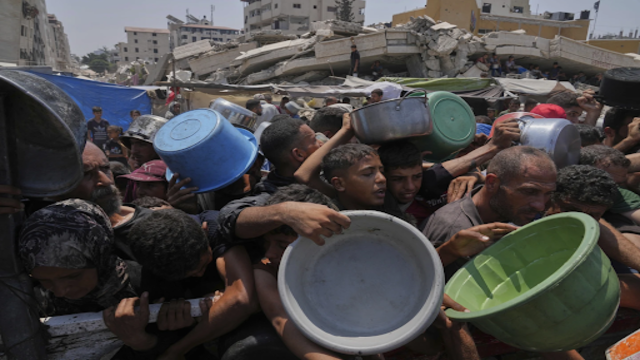
Palestinians struggle to get donated food at a community kitchen, in Gaza City, northern Gaza Strip, Saturday, July 26, 2025. Associated Press
President Donald Trump has announced a new plan to partner with Israel to set up food centers in Gaza. The move aims to address the growing humanitarian crisis caused by hunger and displacement in the region. However, the announcement lacks crucial details and has raised concerns among humanitarian organizations and U.S. lawmakers.
Trump Pushes New Gaza Food Initiative
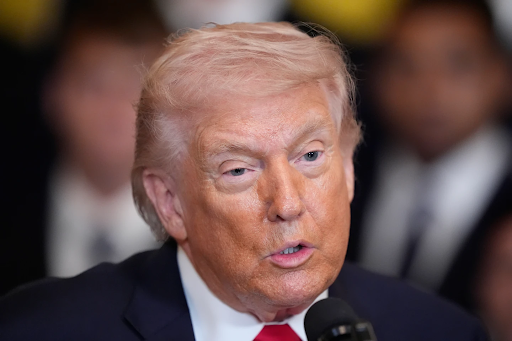
Speaking aboard Air Force One, Trump said the centers will operate under Israeli oversight to ensure proper distribution.
“We’re going to be dealing with Israel,” he said, expressing confidence in Israel’s ability to manage the aid.
The initiative comes as pressure mounts on the U.S. to do more for starving civilians in Gaza. Shocking images of malnourished children have triggered global outrage and calls for urgent intervention.
No Clear Plan Yet
While the White House called it a “new aid plan,” officials offered no clarity on how it would function.
State Department spokesperson Tammy Bruce admitted she didn’t know the framework and was waiting for Trump’s return to provide more insight.
The announcement comes after the U.S. recently withdrew from ceasefire talks, blaming Hamas for stalling negotiations.
Lawmakers Demand Better Solutions
Over 40 Democratic senators, including Sen. Tim Kaine, urged Trump to resume ceasefire talks and rethink the aid strategy.
Kaine criticized the current Israeli-backed food aid system, questioning why trusted humanitarian agencies were being sidelined.
“If we want to solve the problem, turn to the folks who’ve done this for decades,” Kaine said.
Repackaged or New? Doubts Linger
Trump’s proposed centers bear strong resemblance to an earlier aid effort launched in May. That plan, led by the Israeli-backed Gaza Humanitarian Foundation (GHF), set up four food distribution sites after Israel had restricted imports for over two months.
Israel and GHF claimed the initiative was necessary to prevent Hamas from seizing aid. But the U.N. dismissed those claims, saying there was no evidence of significant diversion.
Safety Concerns at Food Distribution Zones
Distribution sites managed by GHF lie in Israeli military zones, off-limits to independent media.
Palestinian witnesses and health officials report that hundreds have been killed while trying to access aid.
Israel maintains its forces have only fired warning shots. GHF says it uses pepper spray and airshots to control crowds.
The United Nations has refused to work with GHF, arguing that forcing desperate civilians to travel long distances through dangerous territory violates core humanitarian principles.
Trump Distances Himself from Netanyahu
Interestingly, Trump has recently broken ranks with Israeli Prime Minister Benjamin Netanyahu over the handling of Gaza.
He referenced disturbing photos of starving children as the reason for his change in tone.
“These are kids that are starving. They’ve got to get them food,” Trump said. “And we’re going to get them food.”
MAGA Base Reacts to Gaza Crisis
Trump’s shift aligns with a growing segment of his MAGA base that is rethinking unconditional support for Israel.
Representative Marjorie Taylor Greene condemned the violence on both sides and described the crisis in Gaza as “genocide.”
Her remarks have sparked debate but don’t represent the entire MAGA movement.
Right-wing figure Charlie Kirk pushed back, calling the Gaza starvation claims a “propaganda campaign” aimed at discrediting Israel.
Trump’s announcement reflects rising concern over the humanitarian crisis in Gaza, yet it leaves many questions unanswered.
With minimal clarity on logistics and execution, and pushback from lawmakers and aid agencies, the effectiveness of this proposed U.S.-Israel partnership remains uncertain.