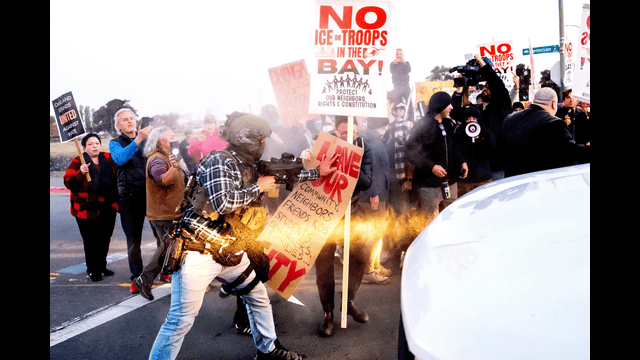
A person pushes a protester blocking a caravan of U.S. Customs and Border Protection personnel trying to enter Coast Guard Base Alameda on Thursday, Oct. 23, 2025, in Oakland, Calif.
President Donald Trump has pulled back his plan to send federal agents and the National Guard into San Francisco after discussions with city officials and business leaders. The decision came amid growing criticism and public protests over fears of militarized law enforcement in the Bay Area.
Trump Reconsiders After Conversations with City Officials
Trump initially announced plans to deploy federal agents to “quell crime” in San Francisco. However, he changed course following a late-night conversation with Mayor Daniel Lurie and prominent executives, including Salesforce CEO Mark Benioff and Nvidia CEO Jensen Huang.
According to Trump, these leaders urged him to reconsider, assuring that local authorities are already taking strong measures to clean up the city.
“The Federal Government was preparing to ‘surge’ San Francisco,” Trump wrote on social media. “But friends of mine who live in the area asked me not to go forward. I spoke to Mayor Lurie, and he asked for a chance to turn things around.”
Mayor and Governor Call Deployment “Unnecessary”
Mayor Lurie and California Governor Gavin Newsom maintained that sending the National Guard was unwarranted, noting that crime rates in San Francisco are actually declining.
At a press conference, Lurie said he appreciated the president’s willingness to listen. He also reaffirmed the city’s ongoing collaboration with federal law enforcement agencies like the Drug Enforcement Administration to combat narcotics-related offenses.
“But having the military or militarized immigration enforcement in our city will hinder our recovery,” Lurie emphasized.
Governor Newsom echoed those sentiments on social media, saying, “Trump has finally, for once, listened to reason. The Bay Area represents what makes California special, and disrupting our progress would only set us back.”
Confusion Over Federal Presence
Earlier Thursday, U.S. Customs and Border Protection (CBP) agents had arrived at a Coast Guard base in Alameda, prompting uncertainty about the administration’s actual plans. It remained unclear whether Trump’s reversal applied to the National Guard, immigration enforcement, or both.
Homeland Security Secretary Kristi Noem reportedly “reaffirmed” Trump’s latest commitment to pause the operation. The Department of Homeland Security (DHS) oversees CBP and Immigration and Customs Enforcement (ICE).
Protests Erupt at Coast Guard Base
The news of federal agents’ arrival triggered early-morning protests at Coast Guard Island in Alameda. Several hundred demonstrators gathered outside the facility, holding signs reading “Protect our neighbors” and “No ICE or troops in the Bay.”
Witnesses reported that police used at least one flash-bang grenade to disperse protesters near the entrance. Despite the tension, organizers repeatedly urged the crowd to remain peaceful.
Gala King, a participant in an interfaith vigil, said the protests were about protecting the region’s diversity. “The Bay Area is a beautiful place full of diversity, and we are here to protect that,” she said. “Our faith traditions call us to stand with the marginalized and those being targeted right now.”
A Broader Pattern of Federal Crackdowns
Trump has previously deployed the National Guard to cities like Washington, D.C., and Memphis, citing concerns about “rampant crime.” His administration also attempted to send troops to Los Angeles, Chicago, and Portland. However, lawsuits from Democratic officials have so far blocked military involvement in city streets.
Local leaders argue that such actions risk escalating tensions rather than resolving crime. San Francisco’s officials believe continued collaboration—not confrontation—will sustain the city’s progress in reducing violence and supporting recovery.