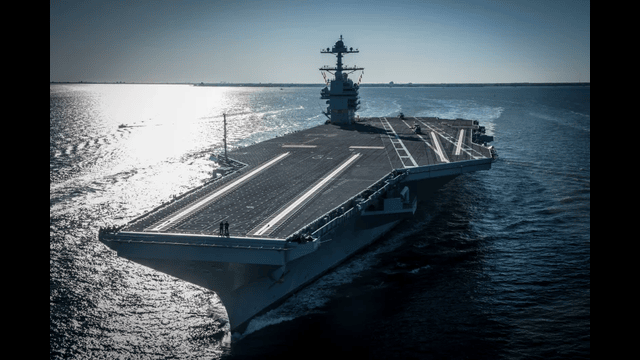
In this photo provided by the U.S. Navy, the USS Gerald R. Ford embarked on the first of its sea trials to test various state-of-the-art systems on its own power for the first time, April 8, 2017, from Newport News, Va.
U.S. President Donald Trump has renewed his warning that Iran must agree to a deal soon. He said serious consequences could follow if negotiations fail. The remarks came as U.S. military deployments increase across the Middle East, raising fears of possible confrontation.
Military Pressure Builds Around Iran
A second American aircraft carrier is moving closer to the region.
The USS Gerald R. Ford is currently positioned near the Mediterranean approaches.
Its movement strengthens Washington’s ability to launch operations if required.
Officials stress the deployment does not confirm an imminent strike.
However, it significantly boosts U.S. readiness for rapid military action.
Security planners expect full operational forces to be positioned by mid-March.
Additional aircraft have also arrived in Gulf bases.
Reports indicate dozens of advanced fighters now support existing regional deployments.
Trump Repeats Deal-or-Consequences Message
Speaking Thursday, Trump emphasized the urgency of reaching a “meaningful” agreement with Iran.
He warned that failure to secure a proper deal would lead to “bad things.”
The administration continues indirect nuclear negotiations held recently in Geneva.
Iran has reportedly agreed to prepare a written proposal addressing U.S. concerns.
American officials have not disclosed when Tehran must submit the response.
Internal national security meetings continue to review diplomatic and military options.
Iranian Leaders Issue Strong Warnings
Iranian representatives responded with their own sharp statements.
Officials warned that any hostile action would trigger defensive retaliation.
They said U.S. bases and assets could become legitimate military targets.
Earlier this week, Iran conducted live-fire exercises near the Strait of Hormuz.
The narrow waterway handles roughly one-fifth of global traded oil.
Military drills in that zone always raise international concern.
Joint Iran-Russia Naval Exercises Raise Attention
Iran also carried out joint naval drills with Russia.
The exercises took place in the Gulf of Oman and nearby Indian Ocean waters.
Officials said the drills aimed to improve coordination and operational experience.
Video footage showed Revolutionary Guard naval forces boarding vessels during the operation.
These units previously seized ships in disputed international waterways.
Iran also issued rocket-launch warnings to aircraft flying nearby.
Regional Diplomacy and Private Warnings
A senior regional official revealed private conversations with Iranian authorities.
He reportedly urged Tehran to treat Trump’s threats seriously.
The official suggested focusing negotiations first on nuclear limits.
He warned that a limited U.S. strike could backfire politically.
Such action might push Supreme Leader Ali Khamenei to withdraw from talks completely.
Diplomats remain concerned about losing the fragile negotiation channel.
Internal Tensions Rise Inside Iran
Domestic unrest continues to simmer within Iran.
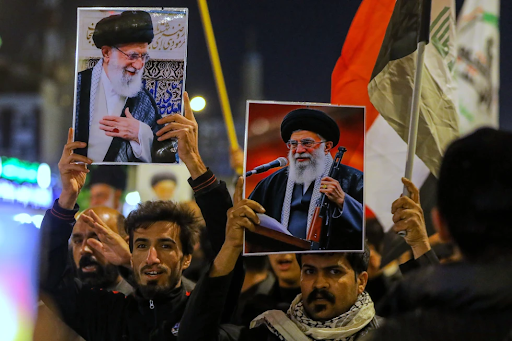
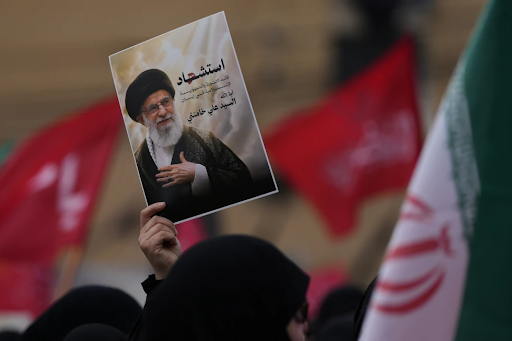
Memorial ceremonies for slain protesters have drawn renewed anti-government chants.
Security forces have warned citizens against further demonstrations.
These internal pressures complicate Tehran’s negotiating position.
Leaders must balance domestic stability with international diplomatic pressure.
International Governments Issue Safety Signals
European governments are monitoring developments closely.
Polish Prime Minister Donald Tusk urged Polish citizens to leave Iran immediately.
He warned evacuation could soon become impossible.
Germany has already relocated some non-essential personnel from northern Iraq.
Officials said the move aligns with precautionary steps taken by allied forces.
Israel Signals Readiness for Any Scenario
Israel is also preparing for potential escalation.
Prime Minister Benjamin Netanyahu said Israel stands ready for every possible outcome.
He warned Iran would face overwhelming retaliation if it launched attacks.
Netanyahu has consistently pressed Washington for stronger measures.
He argues any agreement must curb Iran’s missile program and militant alliances.
Nuclear Dispute Remains the Core Issue
Iran insists its nuclear activities are peaceful and defensive.
Western governments suspect the program could eventually support weapons development.
Tehran claims enrichment halted after last summer’s U.S. and Israeli strikes.
Trump previously said those strikes destroyed Iran’s nuclear infrastructure.
Independent verification remains difficult because inspectors lack full access.
For now, diplomacy continues alongside visible military preparation.
The coming weeks may determine whether negotiations succeed or tensions deepen further.