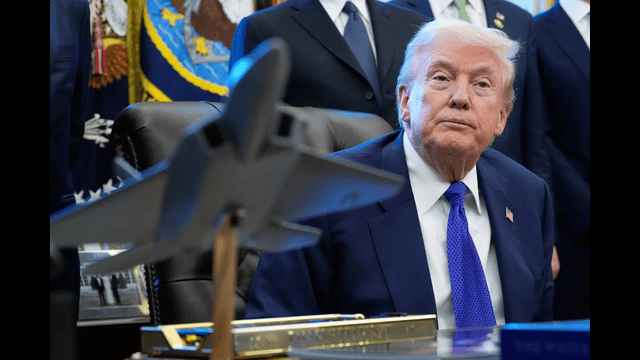
President Donald Trump listens to a question from a reporter.
The Trump administration is facing criticism for its portrayal of the Mexican-American War.
Historians say the White House distorted history to justify tougher policies toward Latin America.
The controversy erupted after a statement marking the war’s anniversary.
The statement praised the conflict as a defining American victory.
It framed the war as a moment that secured sovereignty and expanded freedom.
Critics argue this version ignores historical realities and human costs.
White House Statement Draws Fire
The unsigned White House message described the war as a “legendary victory.”
It claimed the conflict protected the American Southwest.
It also linked the 19th-century war to current U.S. security policies.
The statement said modern border enforcement followed lessons from the past.
It portrayed U.S. actions as defensive and necessary.
Historians quickly challenged that framing.
Key History Left Out
Experts noted glaring omissions in the Trump Mexican-American War narrative.
The statement ignored slavery’s role in the conflict.
It also praised the era of Manifest Destiny without context.
That period led to the displacement of Native American communities.
Hundreds of thousands were forced from their lands.
Critics say glorifying it erases painful truths.
Scholars Call It Historical Revisionism
Alexander Aviña of Arizona State University condemned the statement.
He said it downplayed extreme violence used to expand U.S. territory.
He also linked it to modern U.S. actions in Latin America.
Aviña pointed to recent U.S. involvement in the region.
These include political pressure, election interference, and regime change.
He said the administration framed imperialism as self-defense.
According to Aviña, past leaders viewed the war as shameful.
The Trump administration, he said, celebrates it instead.
That shift alarms historians across the country.
Social Media and Regional Reaction
Criticism spread quickly online after the statement’s release.
Many users accused the administration of rewriting history.
Others warned of rising regional tensions.
Mexican President Claudia Sheinbaum responded with visible disbelief.
She laughed during a press briefing when asked about the statement.
She stressed Mexico’s sovereignty must be respected.
Sheinbaum has used measured diplomacy with Trump.
At times, she has responded with subtle sarcasm.
This includes reactions to symbolic U.S. gestures toward Mexico.
Why the War Still Matters
The Mexican-American War lasted from 1846 to 1848.
It followed border disputes and the U.S. annexation of Texas.
American settlers had already moved into Mexican territory.
Mexico had outlawed slavery at the time.
Many U.S. abolitionists feared expansion meant new slave states.
Those tensions fueled opposition to the war.
After defeat, Mexico ceded vast lands to the United States.
These included present-day California, Arizona, and Texas.
The loss reshaped North American politics permanently.
Former President Ulysses S. Grant later condemned the war.
He called it unjust and driven by power imbalance.
His words still resonate today.
A Pattern of Reframing History
Historians say the statement fits a broader pattern.
Albert Camarillo of Stanford called it imperialist and ahistorical.
He said it reshapes language to fit “America First” ideology.
The Trump administration has ordered changes at the Smithsonian.
Officials said they were restoring “truth and sanity.”
Critics argue this removes uncomfortable facts.
Government websites have also been altered.
References to slavery and Native American destruction were removed.
Climate change content has also disappeared.
Ongoing Diplomatic Sensitivity
The Mexican-American War remains a sensitive topic.
It often resurfaces during moments of U.S.-Mexico tension.
Sheinbaum frequently reminds Washington of Mexico’s independence.
Historians warn against politicizing the past.
They say distorted history risks inflaming regional relations.
The debate shows how history still shapes modern power.