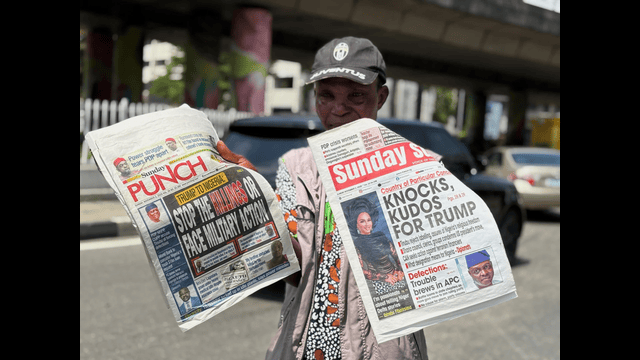
A vendor sells local news papers with headings referring to US President Donald Trump’s comments about Nigeria.
Nigeria has firmly rejected former U.S. President Donald Trump’s threat of potential military action over alleged Christian persecution. The West African nation insists that no foreign country can unilaterally conduct military operations within its borders.
Trump’s Controversial Statement
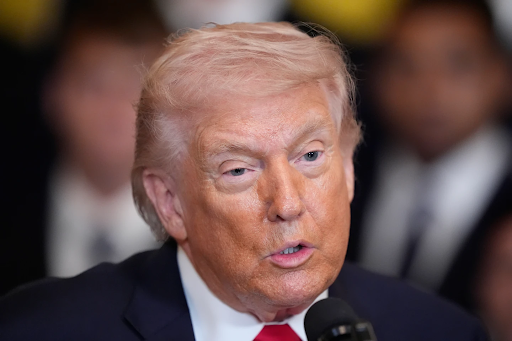
Donald Trump recently claimed that the U.S. might “go in guns blazing” to stop what he described as Christian killings in Nigeria. In a social media post, he accused the Nigerian government of ignoring attacks on Christians. He also warned that the U.S. would stop all aid to Nigeria if the situation continued.
Trump’s comments came after Republican Senator Ted Cruz and several American celebrities alleged that Christians were facing genocide in Nigeria. However, no credible evidence supports these claims.
Nigeria Calls Reports Misleading
Presidential spokesman Daniel Bwala dismissed Trump’s comments as “misleading and outdated.” He said such statements reflect Trump’s “forceful style” of creating pressure to start negotiations.
Bwala clarified that any foreign military action would require mutual agreement between leaders of both nations. “Nigeria is a sovereign country. No one can act unilaterally on its soil,” he said.
He added that Trump and Cruz were referring to old reports from the early days of Boko Haram’s insurgency more than a decade ago.
Both Christians and Muslims Affected
Experts and local leaders argue that Nigeria’s violence is not religiously motivated. Attacks have affected both Christians and Muslims across the country.
The Associated Press confirmed that victims of Nigeria’s many security crises are often targeted based on location and not religion. Boko Haram and other armed groups mainly operate in northern Nigeria, where they attack farming and herding communities alike.
Pastor Joseph Hayab, former chairman of the Christian Association of Nigeria in Kaduna, also rejected claims of organized Christian persecution. However, he urged the government to improve security in conflict-ridden areas.
Tinubu Government’s Response
President Bola Tinubu has refused to accept the U.S. allegations. He emphasized that Nigeria values its partnership with the United States but warned against any threat to its sovereignty.
Tinubu promised to work with international partners to “protect communities of all faiths.” His administration has also intensified military operations against violent groups and replaced several security chiefs to strengthen defense efforts.
Complex Roots of Violence
Nigeria’s ongoing violence has deep social and economic roots. Armed gangs, many made up of former herders, have turned to banditry after years of clashes with farming communities.
Security analyst Taiwo Hassan Adebayo from the Institute of Security Studies explained that geography plays a bigger role than religion in these conflicts. “Who becomes a victim depends on where the violence happens,” he said.
Critics Point to Government Failures
While many analysts reject the idea of Christian persecution, they agree the government has been slow to act. Cheta Nwanze of SBM Intelligence described the situation as a “massive state failure.” He said weak governance and poor law enforcement have allowed violent groups to operate with impunity.
Adebayo added that Nigeria’s inability to tackle insecurity has opened doors for external criticism. “The pressure from Washington didn’t come from nowhere. It reflects years of inaction,” he said.
Nigeria Defends Its Sovereignty
For now, Nigeria stands firm against any foreign interference. Officials say the country welcomes international cooperation but will not tolerate unilateral threats or military planning by any foreign government.
As tensions rise, analysts stress that solving Nigeria’s security challenges requires stronger leadership, local engagement, and clear communication with allies—rather than threats from abroad.