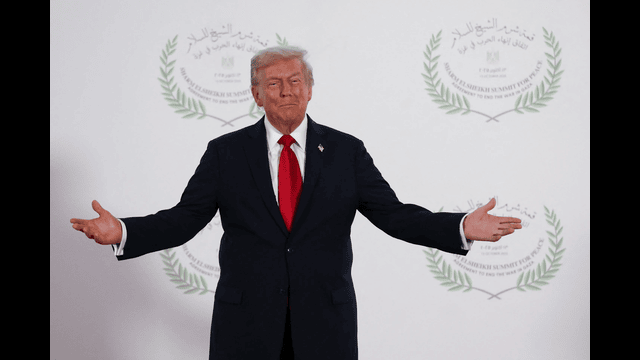
President Donald Trump waits to greet leaders during a summit to support ending the more than two year Israel and Hamas war in Gaza after a breakthrough cease fire deal, Monday, Oct 13, 2025.
With the fragile Gaza ceasefire taking hold, President Donald Trump is redirecting his focus toward ending Russia’s war in Ukraine. The former president, who has made conflict resolution a key part of his foreign policy agenda, now aims to push Moscow to the negotiating table — even if it means arming Kyiv with long-range weaponry.
Trump Eyes Peace Talks After Gaza Truce
Following the success of the Israel-Hamas ceasefire and hostage exchange deal, Trump expressed optimism about achieving a breakthrough in Europe. Speaking at a White House dinner on Wednesday evening, he said recent developments in the Middle East could help pave the way for diplomacy in Ukraine.
“Interestingly, we made progress today because of what’s happened in the Middle East,” Trump told supporters. Earlier in Jerusalem, he predicted that the truce could help the U.S. strengthen ties between Israel and its Middle Eastern neighbors.
However, Trump made it clear that his top foreign policy goal now is to end the Russia-Ukraine conflict — the largest war in Europe since World War II. “First, we have to get Russia done,” he said, addressing his special envoy, Steve Witkoff, who has been his chief link to Russian President Vladimir Putin.
Trump Considers Tomahawk Missiles for Ukraine
Trump is scheduled to meet Ukrainian President Volodymyr Zelenskyy on Friday, marking their fourth meeting this year. Ahead of the talks, Trump hinted that he may approve the sale of long-range Tomahawk cruise missiles to Kyiv if Moscow refuses to negotiate.
These U.S.-made missiles, with a range of about 995 miles (1,600 kilometers), would allow Ukraine to strike deep inside Russian territory. Zelenskyy has repeatedly requested such weapons to pressure Russia into peace talks.
Putin, however, has warned that supplying Ukraine with Tomahawks would cross a “red line” and severely damage U.S.-Russia relations. Trump, undeterred, said, “He’d like to have Tomahawks. We have a lot of Tomahawks.”
Analyst Mark Montgomery from the Foundation for Defense of Democracies called the move “a major political signal” but noted that it could take years to train Ukrainian forces to use the system. He suggested Ukraine could instead benefit from a boost in shorter-range missile systems like the Extended Range Attack Munition (ERAM) and Army Tactical Missile System (ATACMS), which the U.S. has already begun supplying.
Renewed Push for Sanctions on Russia
Zelenskyy is also expected to urge Trump to impose tougher economic sanctions on Russia. So far, Trump has focused more on cutting Moscow’s oil revenues by urging NATO allies and partners to halt their purchases of Russian crude.
Trump announced Wednesday that India — one of Russia’s biggest post-invasion oil buyers — had agreed to stop importing Russian oil, a move he framed as a diplomatic victory.
Meanwhile, the U.S. Senate is considering legislation that would impose steep tariffs on nations buying Russian oil, gas, and uranium. Though Trump has not officially endorsed the bill, his administration has reportedly been reviewing it closely. The bipartisan proposal, co-sponsored by Sen. Lindsey Graham (R-S.C.) and Sen. Richard Blumenthal (D-Conn.), aims to tighten economic pressure on Moscow.
A White House official, speaking anonymously, said the administration is working to ensure that any sanctions align with the president’s foreign policy goals and maintain executive flexibility. Treasury Secretary Scott Bessent added that Washington is seeking stronger European cooperation before advancing new sanctions.
“All I hear from the Europeans is that Putin is coming to Warsaw,” Bessent said. “I’m sure he’s not coming to Boston. So, we’ll respond — if our European partners join us.”
Balancing Diplomacy and Pressure
Trump’s renewed focus on Russia reflects his long-standing promise to end global conflicts swiftly. Yet, like President Biden before him, he has faced resistance from Putin in arranging direct peace talks with Zelenskyy.
Still, buoyed by progress in Gaza, Trump appears determined to translate his diplomatic momentum into action on Ukraine. Whether through sanctions, diplomacy, or new arms deals, the coming weeks could define his ability to “get Russia done” — and deliver on one of his central campaign promises.