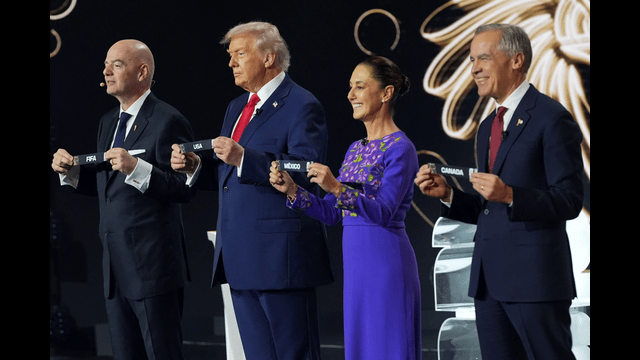
Canadian Prime Minister Mark Carney, Mexican President Claudia Sheinbaum, President Donald Trump and FIFA President Gianni Infantino hold up country names during the draw for the 2026 soccer World Cup at the Kennedy Center in Washington, Friday, Dec. 5, 2025.
President Donald Trump and Mexican President Claudia Sheinbaum finally met in person for the first time during the 2026 World Cup draw in Washington. The long-awaited meeting came more than ten months into Trump’s term, making the delayed encounter a major diplomatic development between the two neighboring nations.
Their discussion revolved around the World Cup, trade, and ongoing tariff disputes. Surprisingly, immigration — one of Trump’s signature issues — was not the focus.
A Long-Delayed First Meeting
Trump was initially expected to meet Sheinbaum at the G7 summit in June, but an early return to Washington amid Middle East tensions forced the cancellation. Since then, the leaders had spoken by phone, often addressing tariffs, border security, and fentanyl trafficking, but had never met in person.
The eventual meeting came during the World Cup draw, where Trump, Sheinbaum, and Canadian Prime Minister Mark Carney appeared together onstage. A private meeting followed.
World Cup Takes Center Stage, but Tariffs Linger
While the 2026 FIFA World Cup served as the public backdrop, trade dominated the private conversation. Sheinbaum reiterated her concerns about U.S. tariffs on automobiles, steel, and aluminum — key sectors of Mexico’s economy.
She later wrote on X that the leaders discussed the “opportunity” presented by the World Cup and agreed to “continue working together on trade issues.”
Trade relations remain guided by the USMCA, the updated version of NAFTA created during Trump’s first term. However, the agreement is under review, and U.S. officials have intensified scrutiny ahead of a major evaluation scheduled for July.
Immigration No Longer the Central Issue
A historic drop in illegal U.S.-Mexico border crossings has shifted priorities between the two governments. Immigration, once the top issue, now shares attention with trade and security concerns.
Still, Trump has continued pushing for aggressive deportation operations in several major U.S. cities, many targeting long-term Mexican residents. The administration claims to focus on “criminal offenders,” though many detained individuals have no violent record.
Falling remittance levels — declining for seven straight months — have also become a major concern for Mexico, especially with a 1% U.S. tax on remittances set to take effect on January 1.
Sheinbaum’s Diplomatic Approach
Sheinbaum has gained a reputation for managing a challenging relationship with Trump through a blend of respect, careful pushback, and occasional humor.
She notably defused tension over Trump’s suggestion to rename the Gulf of Mexico as the “Gulf of America” by jokingly proposing that North America be renamed “América Mexicana.”
Her approach has helped Mexico avoid broader tariff escalations. However, the country still faces 25% automotive tariffs and 50% steel and aluminum tariffs, and negotiations continue as Mexico works to shield its slow-growing economy.
Security and Fentanyl Cooperation
Security cooperation has strengthened under Sheinbaum. Mexico has extradited several cartel figures, including Rafael Caro Quintero, a major figure wanted since the 1980s.
She has empowered security chief Omar García Harfuch, a move welcomed by U.S. officials in the fight against fentanyl smuggling. Improved cooperation marks a stark contrast to tensions faced during previous administrations.
However, Sheinbaum rejected Trump’s repeated proposal to send U.S. troops into Mexico to target cartels. Trump criticized her stance, claiming she feared the cartels — a comment she chose not to escalate, keeping diplomatic stability intact.
A Relationship Shaped by Tariffs, Trade and Strategy
The Trump–Sheinbaum meeting showcased a new phase in U.S.–Mexico relations, driven less by immigration and more by trade, tariffs, and shared security priorities. With the World Cup approaching and trade negotiations intensifying, both leaders appear focused on maintaining cooperation despite tension points.
Their first in-person meeting may prove pivotal as both nations navigate economic uncertainty, major security challenges, and the growing geopolitical weight of North America.