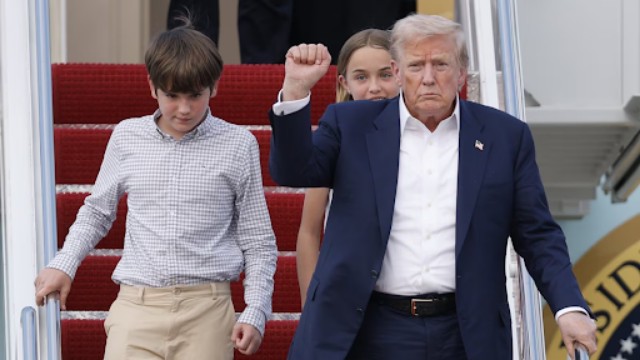
Former President Donald Trump stepped off Air Force One at Joint Base Andrews in Maryland on Tuesday, July 29, 2025, accompanied by his grandchildren, Spencer and Chloe. (AP Photo/Luis M. Alvarez)
In a sharp turn that could rattle global trade dynamics, former U.S. President Donald Trump announced a 25% tariff on goods from India, along with unspecified extra penalties for its ongoing oil purchases from Russia. The new tariffs are expected to take effect this Friday.
Trump announced his Truth Social platform, where he claimed India remains “a friend” but its high tariffs on American products are “unfair.” According to him, India’s trade and defence ties with Russia, including its oil deals, are helping fuel the war in Ukraine. As a result, Trump said, the U.S. would impose a penalty tax alongside the new tariff.
India Reacts to Tariff Shock
India’s Ministry of Trade responded cautiously, stating it is “examining the full impact” of the announcement. Over the past few months, both countries have been negotiating a more balanced bilateral trade deal. India emphasized its continued commitment to achieving a fair and mutually beneficial agreement.
Trump Expands Tariff Strategy Globally
The former president didn’t stop with India. On the same day, Trump signed other trade-related orders, including:
- A 50% tariff on copper imports
- A 50% tariff on Brazilian goods, citing legal action against former President Bolsonaro and alleged bias against American tech firms
- A crackdown on a loophole that allowed small shipments under $800—mainly from China—to avoid import duties
Trump also revealed ongoing talks with a South Korean trade delegation, with 25% tariffs on their goods looming. He mentioned a new oil development deal with Pakistan and continuing trade discussions with China.
What’s Behind Trump's Tariff Push?
Trump’s tariff drive is part of his broader trade strategy. He argues that increasing import taxes can help cut the U.S. budget deficit—exacerbated by recent tax cuts—and revive American manufacturing.
He believes trade negotiations with countries like Japan, Indonesia, the Philippines, and the European Union will open doors for U.S. products and help balance trade flows.
Still, many economists remain skeptical. They warn that such tariffs could lead to higher prices for American consumers and slow economic growth. Experts say the real impact may be passed on to U.S. businesses and households.
European Leaders Push Back
Trump’s aggressive tariff approach isn’t sitting well in Europe. French President Emmanuel Macron said the continent must act faster to protect its economic sovereignty. “To be free, you have to be feared,” he stated during a cabinet meeting, underlining the need for Europe to strengthen its own trade systems and independence.
U.S.-India Ties at a Crossroads
Washington has long viewed India as a crucial partner in Asia, especially in countering China’s growing influence. Prime Minister Narendra Modi and Trump have shared a relatively strong working relationship. Not long ago, Modi agreed to boost energy ties by increasing imports of American oil and gas.
However, the current tariff decision could derail the two nations' ambitious plan to double trade volumes to $500 billion by 2030. The U.S. has sought deeper access to Indian markets, especially in sectors like agriculture and dairy—areas that are politically sensitive in India due to their role in rural employment.
Last year, the U.S. imported significantly more from India than it exported, creating a $45.8 billion trade gap. Indian trade experts worry that new tariffs might shift American demand toward countries like Vietnam or Bangladesh, potentially hurting India’s export-dependent sectors.
Ajay Sahai of the Federation of Indian Export Organizations expressed concern: “We’re in the dark. Trump hasn’t detailed what the penalties are beyond the tariff. But demand for Indian products is sure to decline.”